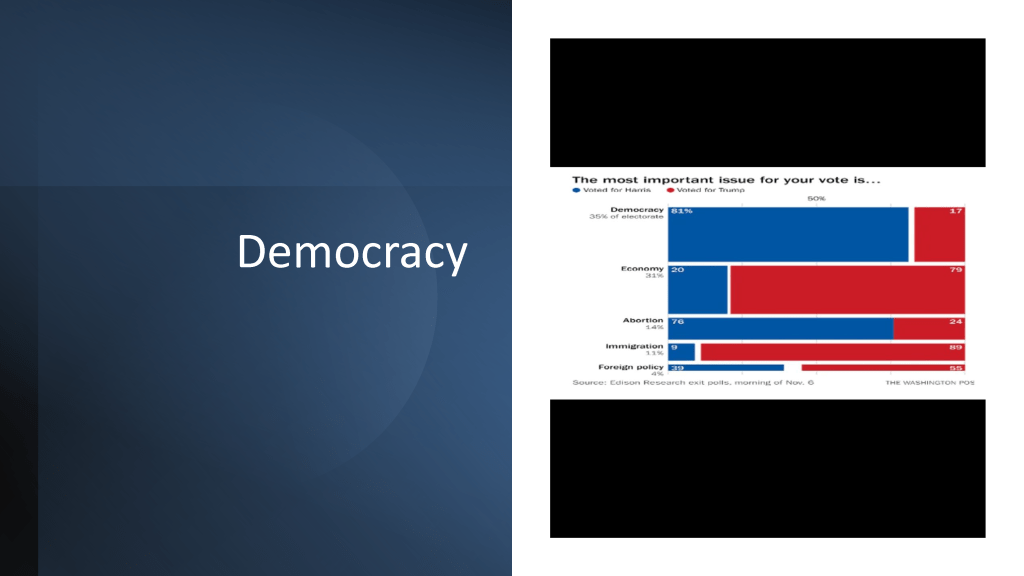
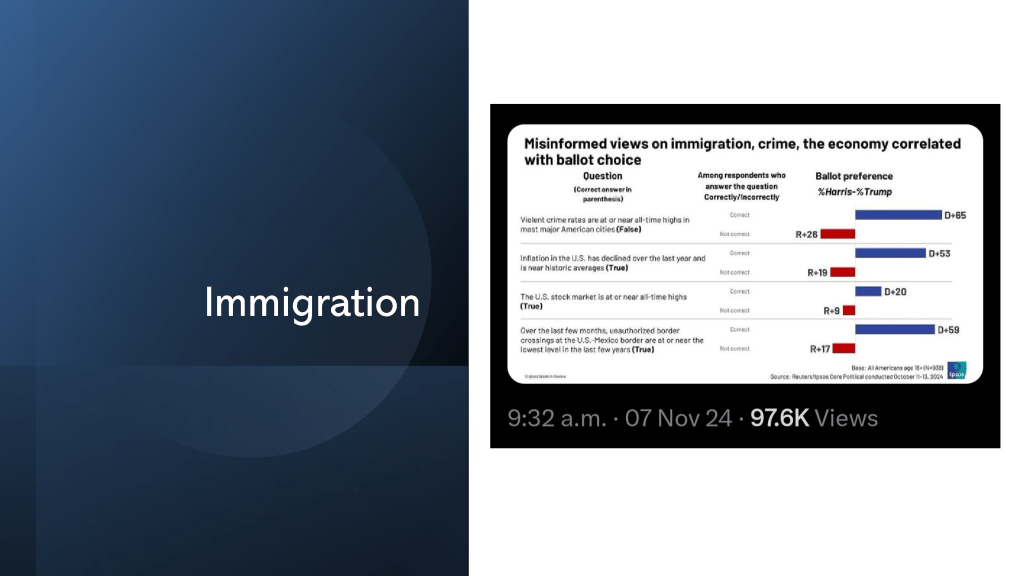
While political scientists know alot, the 2024 election shows that we clearly don’t know everything! The same can be said for our political leaders. In this session we will think about what we have learned and what we still need to learn about elections and forming governments in a democracy after November 2024. Talk February 7 2025
Dalhousie University (Director). (2024, November 20). The 2024 Stanfield Conversation: The US Election and Democracy’s Global Fate | Dalhousie University [Video recording]. https://www.youtube.com/watch?v=zMgA_oJ3mDE
The Summit of the Future laid bare the stark reality of our global predicament. As young voices echoed through the halls, pleading for a better world, the disconnect between rhetoric and action was palpable. With a mere 16% of SDG targets on track for 2030, the clock is ticking, and the world is falling behind.
Leaders paraded their support for renewed efforts, yet their messages blurred into a cacophony of sameness. The elephant in the room remained unaddressed: If we can’t collaborate here, where can we? Who will step up to forge the future we desperately need?
This was nowhere more apparent than in the connections between Sustainable Development Goal 3 (Good Health and Well-being) and SDG 16 (Peace, Justice and Strong Institutions). While there is a stronger recent focus on the link between health and economic or climate goals, the mutually reinforcing goals of health and peace are sometimes overlooked. The ‘siloes’ of politics and strategy operate separately from those of health professions, public health experts, and socioeconomics. Despite the overlaps, there is little discussion between the two communities.
In 1981, the World Health Assembly acknowledged that the role of physicians and other health workers in the preservation and promotion of peace is “the most important factor for attainment of health for all.” Similar initiatives include the World Health Organization’s Peace Through Health plan, begun in the 1990s; and the Health as a Bridge for Peace (HBP) framework, was formally accepted by the 51st World Health Assembly in 1998.
But the onus should not only be on the health sector: diplomats, security experts and foreign policy analysts should note the importance of the connection between health and peace. Similarly to the women, peace and security agenda, the health and peace agenda enables ‘multi-solving’ by addressing the root causes of violence and conflict. Protecting health security inoculates against violence in its many forms. Attention to health security during post-conflict reconstruction reduces the potential for violence to feed into vicious cycles of retribution.
The pandemic exposed the critical need for global health diplomacy. Instead of uniting against a common threat, leaders retreated into nationalist health security postures, squandering chances for conflict resolution through health diplomacy.
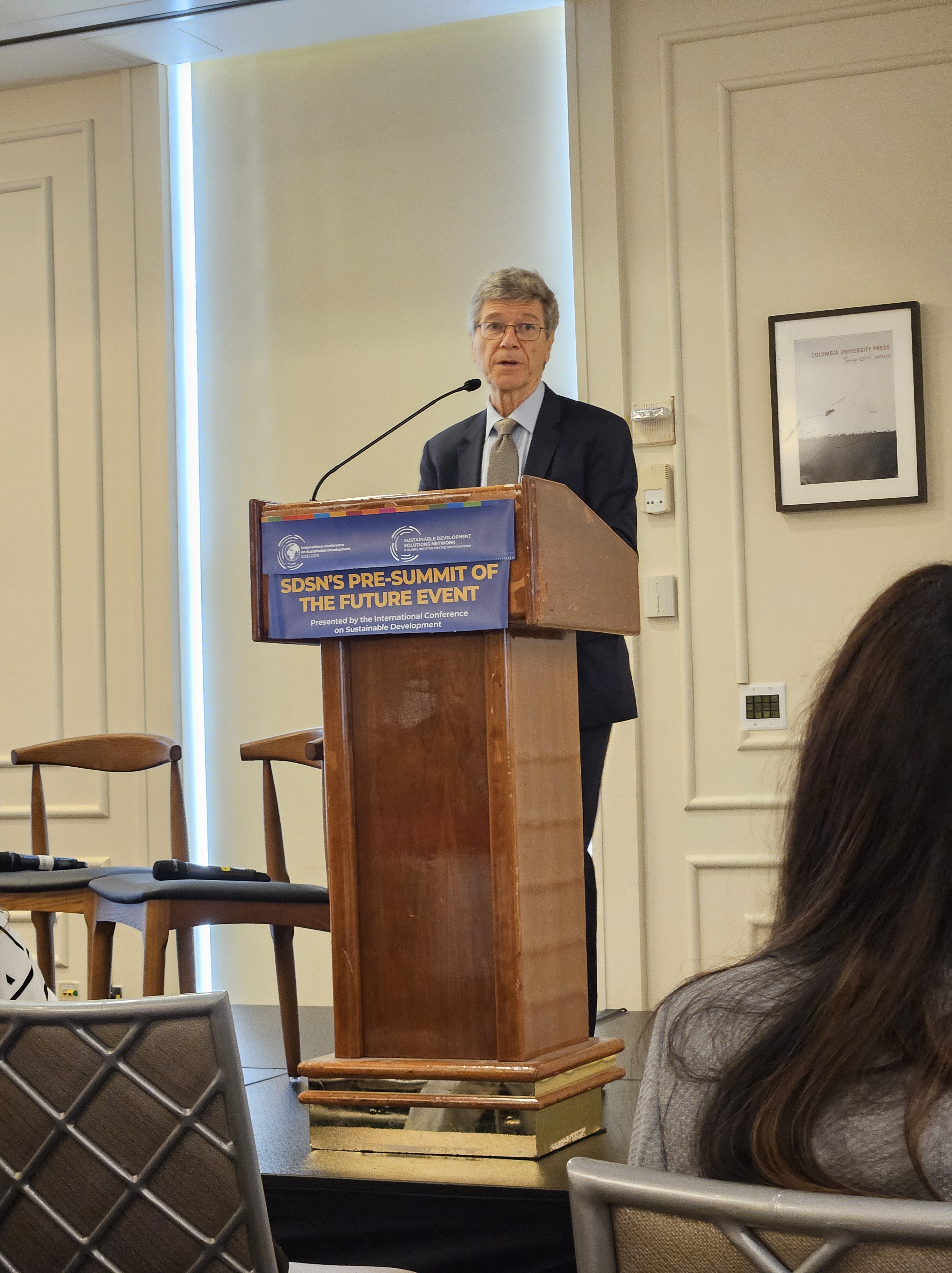
Dr. Jeffrey Sachs speaks at the Pre-Summit of the Future at Columbia University, September 2024
Amidst the gloom, glimmers of progress shine through:
On September 21st 2024, the International Day of Peace, as part of the UN General Assembly Action Days, I was struck by the comments of Juan Manuel Santos, Former President of Colombia and 2016 Nobel Peace Prize recipient. He noted the strong connection between health and peace when he observed the way in which the civil war conflict in Colombia changed over time. As he said, “when soldiers were taken to hospital instead of being killed, it changed the dynamic: when one could trust that the other side would respect their humanity, the level of trust rose on all sides. The ‘enemy’ became human.”
Similarly, in 1859 when Swiss businessman Henri Dunant heard the cries of the wounded on the plains following the Battle of Solferino and called for a halt in the fighting to organize aid, a shift took place that changed the world forever. Dunant’s proposal to create national relief societies to provide neutral and impartial care during conflicts led to the formation of the International Committee of the Red Cross in 1863 and the adoption of the first Geneva Convention in 1864. Ever since, heeding the needs for health has been a powerful lever for upsetting the vicious cycle of violence. In September, fighting was paused in Gaza to enable the vaccination of 640,000 children from the scourge of polio. This effort was not an outlier: the World Health Organization has assisted with vaccine drives during humanitarian crises in many other parts of the world, including the Congo in 1999, where the immunization-related days of tranquility enabled the vaccination of 80% of 10 million children younger than 5 years.
To break the cycle of violence and create a healthier, more peaceful world, we must:
1. Deploy dedicated health diplomats to navigate the geopolitical minefield
2. Revitalize human rights and the Geneva Conventions, prioritizing protection for healthcare workers in conflict zones
3. Boost Official Development Assistance (ODA) for health systems (currently a paltry 0.37% of OECD GNI)
4. Educate relentlessly on the health-peace connection
The Pact for the Future offers a chance to recognize that investing in health creates a powerful multiplier effect on peace. It’s time to move beyond lofty declarations and take decisive action. The future we promised to safeguard is now, and it’s slipping through our fingers.
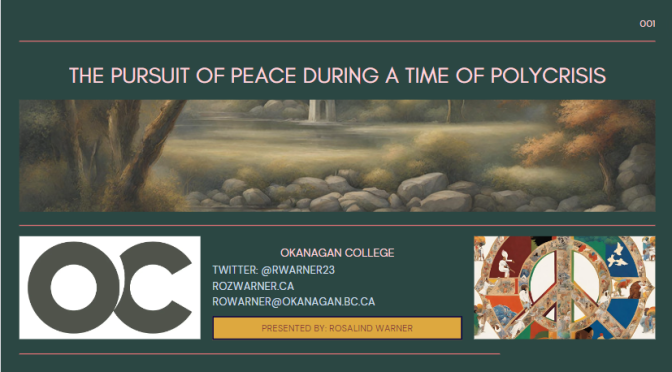
Governments have claimed to be pursuing peace since time immemorial, with seemingly little progress to show for it. Numerous treaties, declarations, laws and covenants have been signed to eliminate war or reduce its effects, yet societies continue to fight and to suffer, despite these efforts. In this talk, we will survey the historical benchmarks of war and peace in world politics, consider where things went wrong, and speculate about how peace might be achieved in the context of an ongoing global crisis.
Southern Resident Orcas are critically endangered despite legal protection
on KSQD 90.7 FM, KSQT 89.7 FM, K207FE(FX) 89.5 FM and KSQD.org
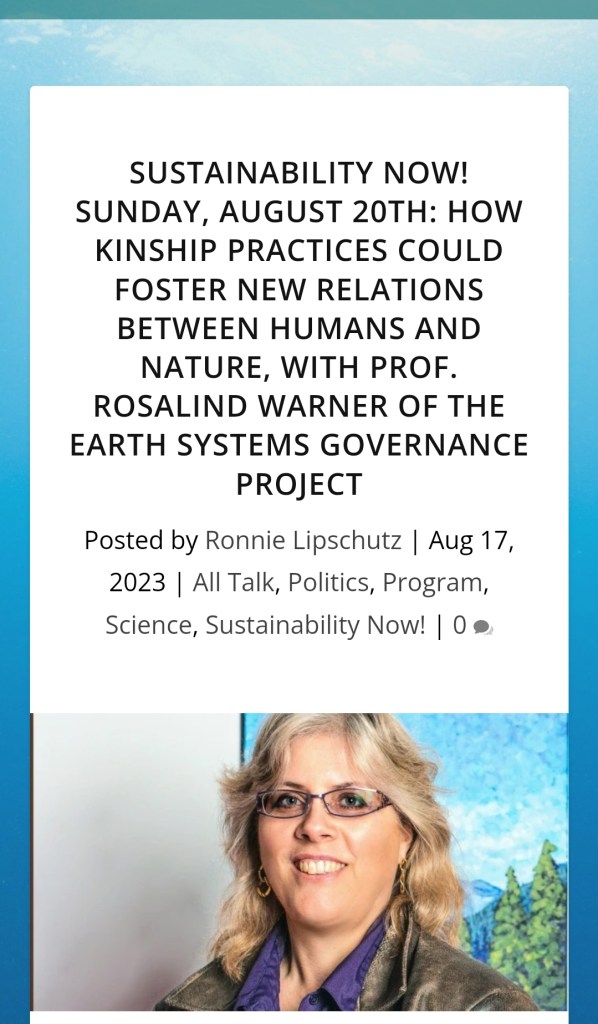
The Rights of Nature is one way to rethink the relationships between humans and Nature, but are there other ways to think about those connections? Join host Ronnie Lipschutz for a conversation with Dr. Rosalind Warner, professor of political science at Okanagan College in British Columbia and Research Fellow with the Earth System Governance Project. Warner is studying the role of kinship metaphors in Earth System Law, with kinship connoting more ethical relationships among humans, Nature and earth’s non-human inhabitants. Earth System Law is an emerging body of legal precepts, principles and practices that bring together ethics and law with the planet’s dynamic physical and biological cycles. Tune in to hear a new take on human-nature relations.
Despite a plethora of treaties, constitutional guarantees, and international organizations, the world continues to be afflicted with senseless atrocities that offend human conscience. Why are institutions powerless against such waves of human cruelty and ruthlessness? This session will explore what can be done to make human rights real. Talk November 14th at Okanagan College, November 18th at SLR.
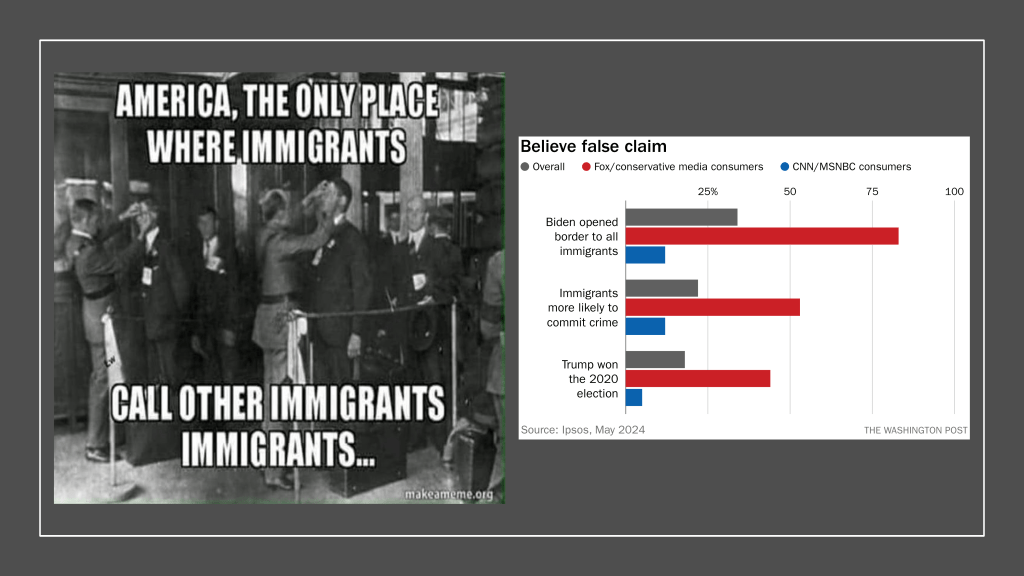
Zhang, L., Lee, E., & Kim, E. (n.d.). IMMIGRANTS IN COVID AMERICA – Xenophobia & Racism. University of Minnesota. Retrieved November 11, 2022, from https://immigrantcovid.umn.edu/xenophobia-racism
Around the world, the institutions of liberal democratic systems are waging a rear-guard action against sustained attacks from populist and extremist movements. These trends are not new, but can be traced to events in the recent past, as well as broader historical developments. In this session, participants will learn why political scientists are so concerned about these trends, and what ordinary citizens can do to improve democratic accountability in Canada.
The foundational idea that women’s rights are integral to the politics of liberation, solidarity and justice has been mainstreamed in many international agreements and organizations.
The momentum on women’s rights should now be strongly carried forward to inform the politics of climate and security.
Moving forward, the need to mitigate and adapt to climate change means the world will be pushed to recognize and institutionalize the principle that women’s security is human security.
The challenge is urgent, the climate will not negotiate. Any efforts to address climate change will be that much poorer for the absence of women’s voices and experiences. Any efforts to address climate change will be that much richer with the power, strength and leadership that women bring as agents of change. The need for human security gives even more reason to ensure that women are not left behind.
In the community I come from, life centres around Okanagan Lake. The Okanagan Valley is a spectacular vista of rounded hills, distant mountains, sparkling waters, and a unique ecosystem for human and non-human life to adapt and thrive.
Despite its apparent permanence, the Valley and the Lake are fragile and vulnerable ecosystems experiencing accelerating pressures from unsustainable patterns of settlement, travel, and economic development. The Valley is vulnerable to insect damage, invasive species, extinctions, drought, fire, flooding, and water contamination. Virtually all of these threats arise from human activities in one way or another.
Looking at it from a birds’ eye view, the Valley is a whole ecosystem, yet the laws that govern it, and those that determine its future, are piecemeal. As I have written before, movements to protect the Valley and the planet can build on holistic thinking using the political and social revolution in human rights. ‘Rights language’ can be used to transform the current framework of laws, policies, and decision making procedures that govern development.
The Valley is a whole ecosystem, yet the laws that govern it, and those that determine its future, are piecemeal.
The progress of human rights is one of the most vital political stories of human history. The broad recognition of rights has a natural logic of expansion and consolidation. Progress comes in waves and is often beaten back by counter-movements, nevertheless, rights language often reemerges in new clothes when violations are at their worst. Violence and abuse trigger a reaction toward conscience and care, and new rights become recognized and affirmed following the worst atrocities.
What does ‘rights language’ bring to environmental causes that other arguments may overlook? Arguments from science, expertise, economic interest and values are sometimes disembodied, ephemeral, remote. An appeal to ‘rights’ triggers foundational debates: the questions become fundamental to identity and society because many rights are enumerated and protected by constitutional law, and because Canadian society has made a point of ensuring that people know and understand what rights are.
As Canadians we also understand that rights have intrinsic value. Most agree that we would prefer to live in a society that recognizes and respects rights, rather than one that does not. While we may not all comprehend the statistical probabilities of climate models or the technicalities of a carbon tax as a policy instrument, we understand ‘rights’. They are a thing. Rights are personal.
Rights are powerful because they are inherently subversive and simultaneously affirming. Raising an issue of water as a right raises questions about the status quo. What are all of the ways that water is freshened, used, transferred, polluted, and acted upon? It prompts rethinking the economic premises of water management. Rights language also prompts us to recognize the intrinsic value of existence. In other words,the recognition of a right elevates the ethical value of a rights holder in the view of the government and society. For example, the right to exist is one of the most fundamental rights possible. A right to exist implies the logical necessity of respecting that existence by not threatening or undermining the integrity and dignity of the rightsholder.
While we may not all comprehend the statistical probabilities of climate models or the technicalities of a carbon tax as a policy instrument, we understand ‘rights’. They are a thing. Rights are personal.
Rights language is also ethical and cultural. The current imbalance between human development and natural protection, evidenced by the global scale of pollution, is at least in part a product of the tendency to view nature in purely instrumental terms. In Western cultural constructions, nature is inert, a dumping ground for human wastes, or a storehouse of potential resources ready for extraction. Nature has not even been seen as a player in the cycle, much less as a rights holder.
The degradation of nature is simultaneously and unavoidably the degradation of humans. Since nature is a closed system, wastes and depletion will circle back to impact human welfare. The Anthropocene is signalling not the supremacy of humans over nature, but rather the exact opposite: the re-embedding of humans back into nature. We are now as much a product of our own activities as we are of natural processes. The world is now fully ‘human’ in at least one sense: the fates of human and nonhuman alike are interlaced in a way not seen before in history. Human and nonhuman fates are planetary in scale.
Restoring balance means revisiting the roots of the gap between humans and nature, the original split that divided the world and made degradation possible, and even celebrated it. That split is symbolized in three ways: 1. the assumption of anthropocentric dominance, 2. the neglect of nature’s intrinsic value, and 3. the separation and distancing of humans from the ecosystems that sustain them (both physical and psychological) .
Laws and politics have tended to wipe nature out of the ethical universe by limiting legal standing to parties with property interests. In other words, the legal conversation about value, loss and damage takes place only among those who are deemed to have an interest, namely, property owners. Even the representation of the public interest is narrowly circumscribed by the necessity of showing direct property-like profits or losses, rather than a public interest in a long-term trust relationship with nature.
While present and recognized in law, the notion of a public trust has not proven to be an effective shield against destruction in the long term, primarily because it can always be trumped or replaced by a new property claim. In addition, property claims are themselves partial since they divide nature up into parcels of utility based on their value to particular property interests. Sky, land, water, and underground are all seen in terms of different types of access, use, and ownership rights.
Solutions to this problem already exist in law, but they are currently found only in isolated and disjointed legal opinions and cases, both locally and around the world. Recently the question of nature rights has risen in prominence in political discussions, partly due to the rising awareness of the planetary nature of environmental damage being experienced in the Anthropocene, and partly due to the increasing recognition of indigenous rights and the distinctly contrasting worldview of nature that such rights represent.
The Whanganui River decision in New Zealand, the rise of Buen Vivir in Ecuador, the Ganges decision and others are pushing back against the notion that nature is nothing more than property, sink, or resource. At the heart of this counter-narrative is the recognition that humans and nature are together, with common fates and interests, and that the inclusion of nature as member of the human family, worthy of respect, care and affection, is essential to human survival. This is represented by indigenous worldviews in varying ways around the world and set down in the UN Declaration of the Rights of Indigenous Peoples as well as many other international legaldeclarations and treaties. Both humans and nature have a right to exist, what is needed (even if it is a first step) is the recognition and affirmation of these new rights in politics, law, and development planning.
This is no small thing, so what are the problems? One may object to the recognition of nature as a rights-holder on various grounds. One objection is that extending rights to nature means the diminution of existing human rights. However, this is not a new argument. This argument is familiar to historians, who documented them in response to the expansion and extension of rights to slaves, women, unpropertied males, and ethnic and religious groups. In every case the historical extension of rights did not result in the reduction of existing rights protections, but instead allowed for the more fulsome exercise of existing rights. This is because the pattern and framework of rights growth reinforces and legitimizes that a universe of moral beings and rights holders exists and is deserving of respect.
Another objection is that nature rights are expensive. Indeed, it is hardly arguable that valuable social and political goals are costly. The question of how to pay for rights has rarely been a strong argument against the recognition of rights, however. Few would argue today that the cost of freeing slaves, or protecting children from abuse are not worth the price of rights enforcement. As well, the social, political and even economic benefits of rights recognition spill over into remarkable new avenues of growth and development. Protecting the right of the lake to flow, to provide recreation and fish and a rich environment has immense economic benefits that should also be taken into account when considering the balance sheet of rights recognition.
Finally, a last objection is that recognizing the rights of a lake necessarily undermines the value of other beings who may be more ‘appropriate’ or ‘deserving’ of rights due to their similarity with or affinity for humans. Why should lakes have rights that are not extended to whales, elephants, monkeys or dogs, all of whom demonstrate more ‘human-like’ characteristics such as family relationships, intelligence, and emotions and feeling? What about microbes or farm animals? What about Mars or the moon or other distant territories? Why lakes and not mountains, or deserts, or garbage piles?
These are all valid and complex issues which should be deliberated and which will likely be decided and come before the courts in the next few years. Awareness is growing about how humans and nonhumans should be governed in a truly planetary ecosystem. It’s important to keep in mind that rights recognition is about governing human action, limiting and allowing different kinds of human interaction with the nonhuman world.
Such rules governing human interactions with the nonhuman world already exist, whether they are laws against animal abuse, or rules about mountain climbing or fishing or logging or nature reserves. The issue is that these rules are currently one-dimensional, shaped disproportionately by property and the need to prove an interest in that property. The rules are insufficiently permanent and not based on inter-generational ethics, and they rely on an out of date worldview of nature, one that is amply demonstrating its failures to protect humans and nature every day.
Rights recognition is about governing human action, limiting and allowing different kinds of human interaction with the nonhuman world.
Rights for lakes will help the larger conversation about how to move beyond the exclusiveness of property, to recognize the limits of the planet and the power of nature to act on human societies. Rights for lakes will reiterate the intrinsic value of the nonhuman world. They won’t solve every problem, but not much can be started without them.
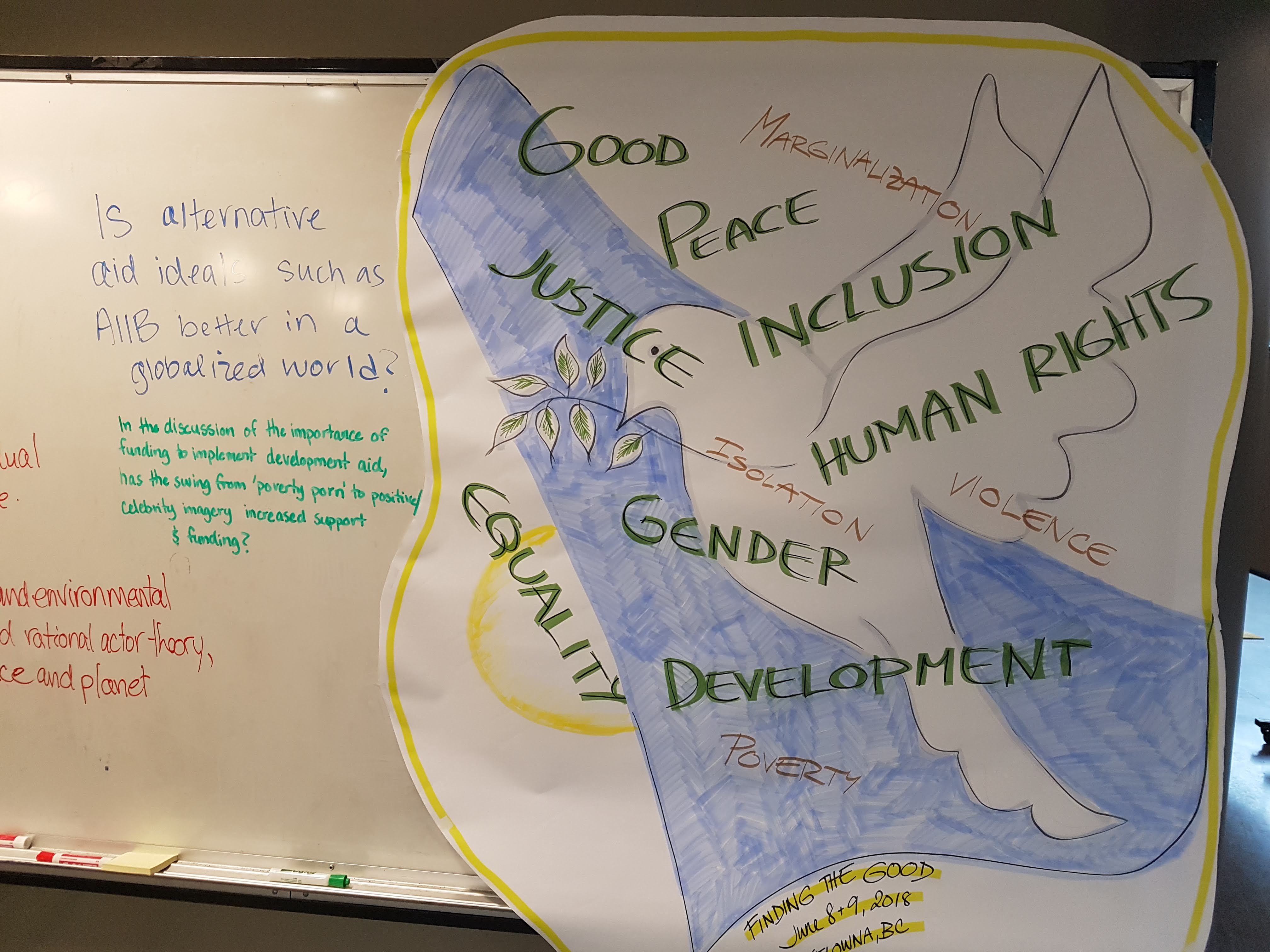
On June 8th and 9th 2018, researchers, students, community members and practitioners gathered at Okanagan College to explore ways of articulating and sharing ethical international development ideas and practices. 50 attendees from across North America joined with leaders locally at Okanagan College’s Kelowna campus for an intensive 2-day conference and dialogue on equality, inclusion, and human dignity. Scholars and practitioners interacted in engaging sessions on gender, local governance, corporate social responsibility (CSR) and the United Nations Sustainable Development Goals (SDGs).
Keynote speaker Chloe Schwenke, former Director of the Global Program on Violence, Rights, and Inclusion at the International Center for Research on Women (ICRW), shared her experiences advocating for a human rights framework for development in the Obama Administration. A second Keynote with Michael Simpson, Executive Director of the BC Council for International Cooperation, built on the themes of leadership and change in a ‘Talkshow’ style interview that engaged the audience in generating new avenues of inquiry.
In addition to providing a summary resource to share the highlights from the two day Conference, the purpose of these Proceedings is to contribute toward a network in which dialogue between scholarly insights and practical development work can improve the participation of people experiencing poverty, social marginalization, discrimination, and oppression both at home and abroad.
For more information and to view the Proceedings, visit the Conference webpage.
As 2018 comes to an end and the world looks to an increasingly uncertain future, it is worthwhile to reflect on the importance of compassion in public life. On the one hand, it seems it should not be necessary to remind ourselves of the need for compassion, while on the other hand, there has never been a time when it is more vital to think about it.
When I speak of compassion I consider it to be similar to the emotion of empathy, which means the ability to identify closely with the feelings of another. However, empathy is an emotion, while compassion is emotion plus action. Empathy is personal, individual, and private. When one experiences empathy, it is not necessarily expressed. Many of us feel empathy for the plight of refugees, but few of us take any action based on those feelings. Compassion is both an expression and an action, something that is a unique responsibility of the powerful. It is the world’s 1% who, due to their elite position, have the most abilityto exercise compassion. Consequently, the world’s 1% (and if you live in a relatively wealthy developed country, you are part of this elite) uniquely bear the moral responsibility to exercise compassion. The exercise and practice of compassion as an action is much rarer than the feeling of empathy, partly because wealth and inequality suppress the expression of compassion. As the world becomes wealthier and more unequal, generosity declines.
Even more unusual is the embedding of compassion into the practices of a society, in other words, through its laws and institutions. Are institutions capable of compassion? Indeed they must be, because if social structures can be violent and oppressive, then it stands to reason that the opposite must also be possible: institutions and laws can be written in compassionate ways, with compassionate ends. It is the public exercise of compassion with which I am most concerned with, because it raises the potential for people to write compassionate institutions and laws. Compassionate laws are necessary because, as suggested, individual empathy can fail – it is temporary, personal, individual and private.
Compassionate laws make it possible for persons to express and act on their feelings of empathy, because they can see that those feelings are socially elevated. The Dali Lama talks about something similar in the Education of the Heart. Compassionate law can help to educate and give permission for people to act on their empathy. To say that law can be compassionate goes beyond a ‘minimalist’ vision of law – that law is only there to level the playing field and justice means equal treatment under the law. Even if law were able to do this leveling, an element of compassion is also essential to the achievement of equal treatment, since law must be attentive to justice. In this sense, human rights law is essentially compassionate in its purpose. Based on observation of the current state of law in the US, it is clearly not able to even achieve the minimal goal of equal treatment or fairness. The gap between law and justice can be reduced with adequate attention to the need for compassionate law.
The kind of compassion I’m thinking about should also be distinguished from altruism, although compassion relies on altruism, they are not identical. Altruism, which is a kind of selflessness, or non-self interested attitude of generosity and giving, is a vital component of compassion, because altruistic motives reduce the temptation to use demonstrations of compassion for self-promotion. Compassionate law is one very effective way to express altruism. Indeed, compassionate law resists self-interested motives by moving altruism from the private to the public sphere and thereby removing the personal motives that might affect compassionate and just outcomes.
The enactment of compassionate law recognizes the innate inequality of human relationships, and works to proactively overcome those inequalities.
Recently, some thinking on giving and charity has been diverted from these concepts of compassion by a concern with effectiveness. Rather than asking how can giving be more compassionate, the question becomes: how can giving be most effective? As one proponent argues: “Instead of doing charity in a way that makes people feel good, effective altruists rely on rigorous, evidence-based analysis to decide how to donate money, where to donate, and which careers are most ethical.” I would argue that this is a diversion. Effective altruists argue using a utilitarian measure: what is good for the most number of people must be the best and most effective form of giving. Using this algorithm, how might one decide between funding one individual’s education and funding a food program for thousands? Probably many more people can be helped with the food program, but over the course of a lifetime what effect might a highly educated individual have, especially if they were able to achieve a position in which they could institute more compassionate laws? The effort to reduce giving to an algorithm sacrifices the element of compassion and arguably undermines the goal of achieving more effective giving. It’s not that effective altruism is wrong, it just kind of misses the point. What is really changed, even if a larger number of people are helped by a given action? There is a risk in reinforcing the status quo and ensuring that giving will continue to be necessary far into the future, violating the goal of achieving truly altruistic giving.
Compassionate laws are necessary because individual empathy can fail – it is temporary, personal, individual and private.
The enactment of compassionate law can, over time and with much learning, come closer to achieving lasting and effective results because it builds-in the principle of altruism by removing self-promotion from the equation. In addition, compassionate law recognizes the innate inequality of human relationships, and works to proactively overcome those inequalities. The human tendency to self-aggrandizement and acquisitiveness is worsened by inequality. Inequality erodes people’s ability to be altruistic and even their ability to empathize. Compassion is needed in a highly unequal world because it is effective, and it is effective because it is authoritative and self-reflexive. The exercise of compassion invites reflection upon one’s own position and relatively good fortune. The proponents of effective altruism are right that relying on natural generosity and emotion is insufficient to make for effective giving, but they are wrong to abandon the idea of compassion, which is needed now more than at any other time of history. This season of giving, consider ways that you might contribute to the establishment of compassionate law, or if this is too ambitious, think about how you can help others express and act on their feelings of empathy, working together with others. For starters, you might consider sharing this post!

















 Dr. Rosalind Warner
You must be logged in to post a comment.