Category Archives: Inequality

Health, Peace, and the Summit of the Future: A Wake-Up Call

The Summit of the Future laid bare the stark reality of our global predicament. As young voices echoed through the halls, pleading for a better world, the disconnect between rhetoric and action was palpable. With a mere 16% of SDG targets on track for 2030, the clock is ticking, and the world is falling behind.

Leaders paraded their support for renewed efforts, yet their messages blurred into a cacophony of sameness. The elephant in the room remained unaddressed: If we can’t collaborate here, where can we? Who will step up to forge the future we desperately need?

This was nowhere more apparent than in the connections between Sustainable Development Goal 3 (Good Health and Well-being) and SDG 16 (Peace, Justice and Strong Institutions).  While there is a stronger recent focus on the link between health and economic or climate goals, the mutually reinforcing goals of health and peace are sometimes overlooked.  The ‘siloes’ of politics and strategy operate separately from those of health professions, public health experts, and socioeconomics.  Despite the overlaps, there is little discussion between the two communities.   

In 1981, the World Health Assembly acknowledged that the role of physicians and other health workers in the preservation and promotion of peace is “the most important factor for attainment of health for all.”  Similar initiatives include the World Health Organization’s Peace Through Health plan, begun in the 1990s; and the Health as a Bridge for Peace (HBP) framework, was formally accepted by the 51st World Health Assembly in 1998.

But the onus should not only be on the health sector: diplomats, security experts and foreign policy analysts should note the importance of the connection between health and peace. Similarly to the women, peace and security agenda, the health and peace agenda enables ‘multi-solving’ by addressing the root causes of violence and conflict.  Protecting health security  inoculates against violence in its many forms.  Attention to health security during post-conflict reconstruction reduces the potential for violence to feed into vicious cycles of retribution.

The pandemic exposed the critical need for global health diplomacy. Instead of uniting against a common threat, leaders retreated into nationalist health security postures, squandering chances for conflict resolution through health diplomacy.
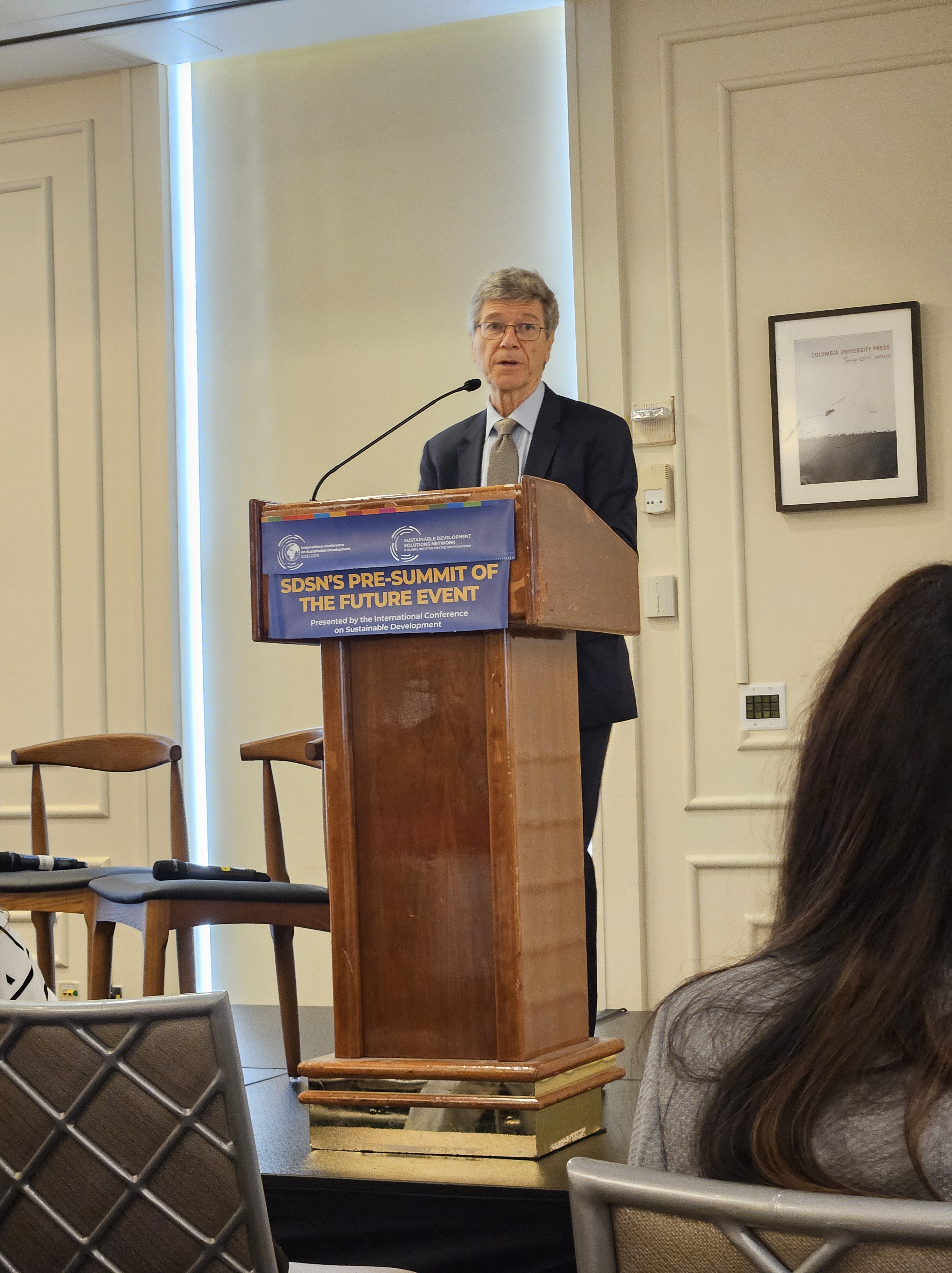
Dr. Jeffrey Sachs speaks at the Pre-Summit of the Future at Columbia University, September 2024

Dr. Jeffrey Sachs speaks at the Pre-Summit of the Future at Columbia University, September 2024

Amidst the gloom, glimmers of progress shine through:

On September 21st 2024, the International Day of Peace, as part of the UN General Assembly Action Days, I was struck by the comments of Juan Manuel Santos, Former President of Colombia and 2016 Nobel Peace Prize recipient. He noted the strong connection between health and peace when he observed the way in which the civil war conflict in Colombia changed over time.  As he said, “when soldiers were taken to hospital instead of being killed, it changed the dynamic: when one could trust that the other side would respect their humanity, the level of trust rose on all sides.  The ‘enemy’ became human.”

Similarly, in 1859 when Swiss businessman Henri Dunant heard the cries of the wounded on the plains following the Battle of Solferino and called for a halt in the fighting to organize aid, a shift took place that changed the world forever.  Dunant’s proposal to create national relief societies to provide neutral and impartial care during conflicts led to the formation of the International Committee of the Red Cross in 1863 and the adoption of the first Geneva Convention in 1864.  Ever since, heeding the needs for health has been a powerful lever for upsetting the vicious cycle of violence.  In September, fighting was paused in Gaza to enable the vaccination of 640,000 children from the scourge of polio. This effort was not an outlier:  the World Health Organization has assisted with vaccine drives during humanitarian crises in many other parts of the world, including the Congo in 1999, where the immunization-related days of tranquility enabled the vaccination of 80% of 10 million children younger than 5 years.

To break the cycle of violence and create a healthier, more peaceful world, we must:

1. Deploy dedicated health diplomats to navigate the geopolitical minefield

2. Revitalize human rights and the Geneva Conventions, prioritizing protection for healthcare workers in conflict zones

3. Boost Official Development Assistance (ODA) for health systems (currently a paltry 0.37% of OECD GNI)

4. Educate relentlessly on the health-peace connection

The Pact for the Future offers a chance to recognize that investing in health creates a powerful multiplier effect on peace. It’s time to move beyond lofty declarations and take decisive action. The future we promised to safeguard is now, and it’s slipping through our fingers.
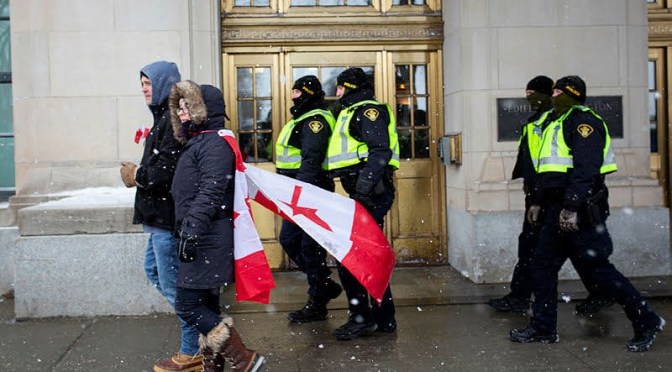

Attack on Democracy

Around the world, the institutions of liberal democratic systems are
waging a rear-guard action against sustained attacks from populist
and extremist movements. These trends are not new, but can be
traced to events in the recent past, as well as broader historical
developments. In this session, participants will learn why political
scientists are so concerned about these trends, and what ordinary
citizens can do to improve democratic accountability in Canada.

Attack on Democracy

Women’s Security is Human Security: Climate and Gender

This blog post was originally produced for BCCIC, read the full post here: https://www.bccic.ca/womens-security-is-human-security-climate-and-gender/

The foundational idea that women’s rights are integral to the politics of liberation, solidarity and justice has been mainstreamed in many international agreements and organizations.

The momentum on women’s rights should now be strongly carried forward to inform the politics of climate and security. 

Moving forward, the need to mitigate and adapt to climate change means the world will be pushed to recognize and institutionalize the principle that women’s security is human security.

The challenge is urgent, the climate will not negotiate. Any efforts to address climate change will be that much poorer for the absence of women’s voices and experiences. Any efforts to address climate change will be that much richer with the power, strength and leadership that women bring as agents of change. The need for human security gives even more reason to ensure that women are not left behind.

Rosalind Warner, 2022

The Need for Compassionate Law

As 2018 comes to an end and the world looks to an increasingly uncertain future, it is worthwhile to reflect on the importance of compassion in public life.  On the one hand, it seems it should not be necessary to remind ourselves of the need for compassion, while on the other hand, there has never been a time when it is more vital to think about it.

When I speak of compassion I consider it to be similar to the emotion of empathy, which means the ability to identify closely with the feelings of another.  However, empathy is an emotion, while compassion is emotion plus action.  Empathy is personal, individual, and private.  When one experiences empathy, it is not necessarily expressed.  Many of us feel empathy for the plight of refugees, but few of us take any action based on those feelings.  Compassion is both an expression and an action, something that is a unique responsibility of the powerful.  It is the world’s 1% who, due to their elite position, have the most ability to exercise compassion.  Consequently, the world’s 1% (and if you live in a relatively wealthy developed country, you are part of this elite) uniquely bear the moral responsibility to exercise compassion.  The exercise and practice of compassion as an action is much rarer than the feeling of empathy, partly because wealth and inequality suppress the expression of compassion.  As the world becomes wealthier and more unequal, generosity declines.

Even more unusual is the embedding of compassion into the practices of a society, in other words, through its laws and institutions.  Are institutions capable of compassion?  Indeed they must be, because if social structures can be violent and oppressive, then it stands to reason that the opposite must also be possible:  institutions and laws can be written in compassionate ways, with compassionate ends.  It is the public exercise of compassion with which I am most concerned with, because it raises the potential for people to write compassionate institutions and laws.  Compassionate laws are necessary because, as suggested, individual empathy can fail – it is temporary, personal, individual and private.

Compassionate laws make it possible for persons to express and act on their feelings of empathy, because they can see that those feelings are socially elevated.  The Dali Lama talks about something similar in the Education of the Heart. Compassionate law can help to educate and give permission for people to act on their empathy.  To say that law can be compassionate goes beyond a ‘minimalist’ vision of law – that law is only there to level the playing field and justice means equal treatment under the law.   Even if law were able to do this leveling, an element of compassion is also essential to the achievement of equal treatment, since law must be attentive to justice.  In this sense, human rights law is essentially compassionate in its purpose. Based on observation of the current state of law in the US, it is clearly not able to even achieve the minimal goal of equal treatment or fairness.  The gap between law and justice can be reduced with adequate attention to the need for compassionate law.

The kind of compassion I’m thinking about should also be distinguished from altruism, although compassion relies on altruism, they are not identical.  Altruism, which is a kind of selflessness, or non-self interested attitude of generosity and giving, is a vital component of compassion, because altruistic motives reduce the temptation to use demonstrations of compassion for self-promotion.  Compassionate law is one very effective way to express altruism.  Indeed, compassionate law resists self-interested motives by moving altruism from the private to the public sphere and thereby removing the personal motives that might affect compassionate and just outcomes.

The enactment of compassionate law recognizes the innate inequality of human relationships, and works to proactively overcome those inequalities.

Recently, some thinking on giving and charity has been diverted from these concepts of compassion by a concern with effectiveness.  Rather than asking how can giving be more compassionate, the question becomes: how can giving be most effective?   As one proponent argues: “Instead of doing charity in a way that makes people feel good, effective altruists rely on rigorous, evidence-based analysis to decide how to donate money, where to donate, and which careers are most ethical.” I would argue that this is a diversion.  Effective altruists argue using a utilitarian measure:  what is good for the most number of people must be the best and most effective form of giving.  Using this algorithm, how might one decide between funding one individual’s education and funding a food program for thousands?  Probably many more people can be helped with the food program, but over the course of a lifetime what effect might a highly educated individual have, especially if they were able to achieve a position in which they could institute more compassionate laws?  The effort to reduce giving to an algorithm sacrifices the element of compassion and arguably undermines the goal of achieving more effective giving.  It’s not that effective altruism is wrong, it just kind of misses the point.  What is really changed, even if a larger number of people are helped by a given action?  There is a risk in reinforcing the status quo and ensuring that giving will continue to be necessary far into the future, violating the goal of achieving truly altruistic giving.

Compassionate laws are necessary because individual empathy can fail – it is temporary, personal, individual and private.

The enactment of compassionate law can, over time and with much learning, come closer to achieving lasting and effective results because it builds-in the principle of altruism by removing self-promotion from the equation.  In addition, compassionate law recognizes the innate inequality of human relationships, and works to proactively overcome those inequalities.  The human tendency to self-aggrandizement and acquisitiveness is worsened by inequality.  Inequality erodes people’s ability to be altruistic and even their ability to empathize.  Compassion is needed in a highly unequal world because it is effective, and it is effective because it is authoritative and self-reflexive.  The exercise of compassion invites reflection upon one’s own position and relatively good fortune.  The proponents of effective altruism are right that relying on natural generosity and emotion is insufficient to make for effective giving, but they are wrong to abandon the idea of compassion, which is needed now more than at any other time of history.  This season of giving, consider ways that you might contribute to the establishment of compassionate law, or if this is too ambitious, think about how you can help others express and act on their feelings of empathy, working together with others.  For starters, you might consider sharing this post!


On Climate Debates: A Political Science Viewpoint

Climate Debates and the Nature of Expertise
I can only imagine how dizzying it must be to try to make sense of climate science as a non-climate scientist.   My background and training doesn’t really equip me to engage in a discussion about the accuracy of climate models, the relative importance of various gas emissions in affecting degrees of heating, or the significance of sea ice extent in the summer in the Arctic.   In fact, my engagement as a political scientist in these debates would be highly counterproductive to the discussion and would contribute zero to the stock of climate knowledge as it pertains to the prognosis for the earth.

The Nature of Science and the Science of Nature

One of the mistakes we often make is confusing scientific debates with political ones.  This is what fed the ‘climategate’ debacle and what continues to make any whiff of scientific controversy pure oxygen for climate skeptics.  However, criticisms of scientists (as opposed to science) mistake the forest for the trees. Scientists are not ‘debating’ the climate so much as they are refining the cumulative knowledge that is their scientific purview, a body of knowledge which is the culmination of centuries of practice, experimentation, rigid application of standards, and a continual cycle of testing and iteration that has stood the test of time.   One might also add the contribution of the body of indigenous knowledge that arises from centuries of close experience with changing ecosystems.  This knowledge has provided a proven basis for human survival and thriving through millennia of climate changes.

One of the mistakes we often make is confusing scientific debates with political ones.

These methods of knowledge production have produced our most reliable and predictable technologies, things that we use every day without questioning or even knowing anything about their scientific basis.   When we check our phones for the correct time or our GPS to figure out how to get to Auntie’s house for dinner, we don’t interrogate the motivations that drive scientists to do their thing, we just make use of it. We’ve forgotten that accurate clocks and navigation systems are the products of the same efforts and methods that produce climate knowledge.

What Role for Political Science?

So, where does that leave me?   Shifting the lens means looking at how people learn, where their confidence in their knowledge comes from, and assessing their claims on the basis of mutual respect for each others’ life experience and formal and informal learning.

Assessing claims over time gives better confidence in their robustness, but it doesn’t necessarily lead to truth.  Knowledge is socially produced, and so helping to understand how and why social innovation happens is one way that political scientists can contribute to our understanding of climate change.

This is the purview of political science – at the core we political scientists are about improving our knowledge about how people learn,  how they come to their beliefs, and how decisions result from that interaction.

What Political Science Might Say

Here’s what political scientists might conclude about the current debates over climate change:

  1. Climate change is a complex of human and nature interactions, incorporating both ecosystem and social system changes.   Ask a biologist – life has shaped the planet as much as the planet has shaped life.
  2. Debates about the causes of climate change say more about the ability of powerful voices to shape discourse than they do about the science or the state of human knowledge.  Check the historical and current role of the fossil fuel industry in shaping discourses.
  3. Humans deploy information as a tool to resolve psychological and social problems, such as cognitive dissonance or hypocrisy.
  4. Humans deploy information as a tool to foment problems because it brings them social benefits such as inclusion and acceptance into a group they aspire to.  This observation applies to scientists as well as everyone else, but scientific testing is explicitly designed to moderate and reduce the impact of this human tendency on the knowledge produced.
  5. Human social reactions to emerging threats vary hugely based on their perceptions, but depend inordinately on social relationships. Human social innovations in response to climate change may be classified into two broad forms:  social control or mobilization.
  6. Those closest to the object of knowledge (ie scientists, marginalized peoples in developing countries, indigenous peoples and their leadership) will be most widely questioned as dissonance grows, they will also be the most likely to try to mobilize their knowledge
  7. Those furthest from the object of knowledge (non-scientists, the wealthy and geographically mobile) will be just as likely to experience dissonance but will prefer social control strategies over mobilization
  8. Human inequality encourages suspicion of the motives of others, which in turn leads to widespread mistrust of knowledge claims of any basis.  This is supported by both observational and experimental evidence.
  9. Mobilization does not require special knowledge or access, nor does it require knowledge to be certain or definitive
  10. Social benefits and costs will not be distributed evenly, leading to further pressures on decision making, as sorting these out distracts from collective action
  11. Cognitive dissonance and time pressures leads human decision making groups to narrow the range of choices available in ways that make decisions ultimately less adaptive and optimal.

Knowledge is socially produced, and so understanding how and why social innovation happens is one way that political scientists can contribute to our understanding of climate change.

What to Do?

Some of these observations are more pessimistic, and some are more optimistic, when it comes to the prospects for taking climate action.  On the pessimistic side, widespread and deep questioning of the basis of human knowledge is most counterproductive when humans most need to grow their knowledge in order to act effectively. On the other hand, the prospects for collective mobilization may grow over time as climate change impacts become more widely felt.

We are in a novel historical moment which challenges the full range of human ingenuity.  Whether mobilization or social control will win out is an open question.  I’d speculate that social innovations tend to be more adaptive in a stable climate than they are in a rapidly-changing climate.  I know which I’d prefer, but history (if it continues at all) will be the ultimate judge.

Is the World Getting Better or Worse (Talk)?

This presentation takes a practical look at recent trends in the world and analyze whether the world is getting better or worse. We will look at trends in democracy, human rights and freedoms, economic growth and inequality, environmental degradation and climate change, human health, population, and governance, among others.

Canada’s Role in a Changing World

The liberal international order (LIO) has been in place for half of Canada’s 150-year existence and Canada has been an integral part of it from the beginning. As one of the founding members of this order Canada has a stake and a role in preserving international law, peace, prosperity and human rights. However, the LIO is under stress. What will be Canada’s response to a new era of diverse challenges? From the U.S. effort to abandon NAFTA to the challenges of terrorism and environmental breakdown, Canada’s capacities are being put to the test. This session will open a conversation about Canada’s strengths, weaknesses, opportunities and threats in a world of rapid and unexpected change.

6 Questions for the Social Academic Disciplines after the US Election

Its been a tough time for practitioners of what I’ll call the Social Arts & Sciences, and for analysts  of political affairs. For example, reputable pollsters were totally wrong in predicting the election of 2016, pretty much destroying any confidence in the utility of analytical methods like survey research. Of course, most consumers of polling data can’t be expected to know the difference between the use and interpretation of quantitative data for research, and the kinds of reckless extrapolation that posed as expert and authoritative analysis leading up to the election.  So, it seems that social scientists have some tasks to do. As a community of thinkers and teachers about social affairs, the Social Arts & Sciences have a unique set of tools for understanding world events that can shed light on important questions. Like any tool, the value of analytical methods is only as good as the use they are put to.

Illuminating who we are as social beings, and why we do what we do, can bring improvements to our shared experience by enabling changes in social behaviour through learning, but only if done carefully and deliberately, and with a great deal of humility and caution.  I’d suggest these following lines of inquiry, but what I can’t do is help sounding like a stuffy, elitist, out of touch intellectal to some.  This is an occupational hazard, but one I’ll have to live with. Sorry about that. Here are some lines of inquiry suggested by recent events:

1. Political Science

Ok this one’s mine.  Please, political scientists, explain clearly the difference between democracy and liberal democracy.  Liberal democracy is a paradox, since the rule of law and constitutional protection of human rights necessarily limits democratic rule. Another way to think about it is that minority protections make democracy possible by ensuring that the people do not abuse their power, and in the process, potentially vote themselves out of power.  Law needs democracy and democracy needs law. They are inextricably bound together.  The rights of minorities are integral to the maintenance of democracy, not an add-on that can be jettisoned in the name of the majority or for the sake of convenience. Protecting minority rights is what enables democracy to function, and to sustain itself. Compromising minority rights inevitably compromises democracy itself.  Protecting minority rights protects everyone.

While we’re at it, please explain what polls actually measure, what they don’t measure, and what their limitations are (and I don’t mean margin of error). Everyone: (yes that means you)…I’m sorry, but you have to take statistics.  We all did it, so you have to too. There.

I’m throwing questions about the Electoral College to the historians.  It makes no sense.

A bonus suggestion for Philosophy:  help everyone understand paradoxes better.

2. Gender and Womens’ Studies

I would like to understand better the dynamics of ‘alpha male’ social behaviour.  I don’t even know if that’s a thing, but it kind of looks like what we’ve been observing. If I’m wrong, can you please school me in another way of understanding why so many thinking, otherwise respectful people (men and women both) willfully compromise themselves and their values when faced with powerful but flawed male figures?  An extra job for sociologists: help us truly understand the centrality of identity to pretty much everything.

3. Psychology

Following the 2008 economic crisis, a new subfield of Economic Psychology flourished to help explain why otherwise rational actors made irrational decisions, even against their own interest, and under what circumstances.  I think we need more of that.  Can psychology help us understand  more about the dynamics of voter decision making,  the processes of skapegoating, and the emergence of in-group and out-group division?  What is the role of emotion as a motivation for decision making?   We know that strong emotion can interfere with rational decision making,  but how might this dynamic work at a community level?

4. History

Please keep telling analogous stories from the past to help give context to the problems of the day.  Each generation still generates its own version of problems and solutions, but if people saw their issues as common and not unique, they might be better able to think creatively about how to apply the wisdom of the past to the present.  Also, please focus as well on the peaceful, constructive periods of history where nothing much happened.   The boring bits are what we can learn from.   As well, can you please help us understand better what happens during times of accelerating and rapid change so societies can learn to be more adaptive?  I have a feeling we’re going to need that.

5. Communications

Ok so you’ve got lots of work ahead…..propaganda has gone viral, driven not by large organizations but by individual users.  Consumers are now transmitters.  Conversations are immediate and global.  Has the speed of communication outpaced democracy?   Please talk to the psychologists about the effects of this on thinking, can we know more about how our social lives and worlds create our  reality?

6. Artists and Writers

Please keep reminding us what it’s like to be someone else.  Touch our hearts with stories of people and places different from our own experiences, so that we can develop empathy and awareness, even for a minute.  Teach the teachers how to convey this effectively. Educate all of the social scientists about the importance of empathy to learning and growing and advancing knowledge about the world and ourselves.  Ultimately, this is the only way humans truly learn.

When States Fail Humanity: Distance, Strangers, and The Home Analogy

Middle East

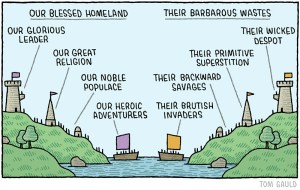
The hearbreaking image of a drowned toddler on the shores of Europe reminded us all of the responsibilities towards others on this planet.  Human ties towards distant ‘others’, however, have historically been loose and fickle. Only rarely do people feel closely committed to the needs and troubles of others beyond their immediate family. Distance usually decreases empathy.  One of the reasons that states appeared was to deliberately overcome this innate human tendency to prioritize close relatives over strangers.  If human settlements were going to work, large communal groupings required closer ties among people who did not interact daily on a face-to-face basis.  To accomplish this, national groupings took on the trappings of families (the ‘motherland’, ‘fatherland’, ‘homeland’) and encouraged people to imagine the state as their proxy family writ large.

However, creating states to bond national groups together had a counter-effect, it created a new category of humans: outsiders and ‘others’ who were encountered only when travel (either by explorers sent out from the homeland or migrants coming in) brought them together.  Today, states have created an elaborate edifice of laws, institutions, informal rules and practices to help them classify and categorize how ‘strangers’ are treated. Partly, these rules have emerged from historical experience and are particular to individual societies.  For example, the European memory of the mass starvation and refugee crises following World War II has shaped the image of what a refugee is today.  Ultimately, because European states had an inordinate influence on the creation of global order in the post-War era, European ideas have heavily influenced international laws. A ‘refugee’ is a classification of people distinct from a ‘migrant’ in two main ways:  1. a refugee has rights to legal process, material support, and protection in the country they are seeking asylum; and 2. a refugee has the right to not be forcibly returned to their country of origin.

Today, states have created an elaborate edifice of laws, institutions, informal rules and practices that help them to classify and categorize how ‘strangers’ are treated.

However, states have jealously guarded their own rights to define someone as a citizen or to keep them out of the national family.  In doing so, states have created legal categories that make no sense when applied to real humans, because states’ rights and human rights conflict.

BarbariansThis background helps us to understand more clearly the landscape of political arguments going on now around migrants, as well as the ways in which the rules are being interpreted and applied.  It also allows us to recognize the limitations of these rules, in particular the ways in which these rules have arbitrarily divided humanity into categories that systematically de-humanize them and construct them as ‘strangers’, outside of the ‘families’ created by states.  The insistence on the application of these rules by state leaders reveals their emptiness.  Insisting that migrants register in the first country of arrival, that they be registered in order to apply for further transit, and that they somehow demonstrate and document that their movements are involuntary, are levers designed to ensure that they remain outside of the national family, not that they be embraced by the protections of refugee law.  Insisting that the solution to the problem is to ‘solve the Syrian conflict’ or ‘eliminate ISIS’ is similarly meant to distract from the fact that migrants have already waited 4 years or longer for the world to do something to help them, and that many thousands of refugees remain in countries closer to their countries of origin in the hope that they may be able to eventually return.  Some of these host countries, including Turkey, have been unwelcoming and hostile to their presence, driving them further afield to find sanctuary.  The insistence that migrants be prevented from ever settling in their countries of refuge ignores the legal invocation that they not be refouled back to danger.  The legal distinction between ‘economic migrants’ and ‘refugees’ is increasingly nonsensical, and the insistence on respecting it only reveals the arbitrariness of the categories.

In light of these realities, it is amazing that some have now decided to re-invoke humanity and the home/family analogy, and have even opened up their homes and lives to help strangers.  The defeat of the

The legal distinction between ‘economic migrants’ and ‘refugees’ is increasingly nonsensical, and the insistence on respecting it only reveals the arbitrariness of the categories.

Harper government in Canada is a rebuke of a legislative program designed to reinforce categories of separation and exclusion, to invoke tribalism in the legal guise of statehood. It is understandable, if not totally forgivable, that this welcoming comes late, and that it comes only with the ever-closer proximity of the suffering of others. Maybe that’s the best that humans can do.  However, states are another matter.  States are created by humans to encourage the compassembrace of strangers into a larger family. The next step is to build on the initiatives begun by states to encourage the expansion of the national family and to begin to challenge the arbitrary categories that divide humanity up.  The human willingness to challenge the separation created by distance has communicated empathy throughout the state system.  What remains is to communicate this to states in the future through new laws that strengthen human ties rather than state rights.
Unsettled Balance: Ethics Security and Canada’s International Relations

Book Cover 2015

New Website for Unsettled Balance Book here!

Since 9/11, the wars on terror, economic crises, climate change, and humanitarian emergencies have led decision makers to institute new measures to maintain security. Foreign policy analysts tend to view these decisions as being divorced from ethics, but Unsettled Balance shows that arguments about rights, obligations, norms, and values have played a profound role in Canadian foreign policy and international relations.

Examining a wide range of events in Canada and abroad, the contributors to this volume collectively explore three key questions. What is the meaning of ethics and security, and how are they linked? To what extent have considerations of ethics and security changed in the twenty-first century? And what are the implications of a shifting historical context for Canada’s international relations?

Whether probing how Canada handles the tension between ethics and security when hosting large-scale international events, engaging in humanitarian aid initiatives, or entering into military operations, each chapter provides insight into key decisions in recent Canadian history. In a time of rapid change, this book is essential reading for anyone who wants to understand how Canada responds to the challenges of an increasingly volatile world and why it responds the way it does.