The concept of planetary health has recently joined a plethora of new vocabulary that sparks new meanings and imaginaries about what constitutes health, what parts of the planet we value, and what the aspirations are for the human and the non-human family. As a social imaginary, planetary health is concerned with issues and problems that are related, but simultaneously embedded with systems of social, economic, political, and environmental architectures of order and change. This video uses the metaphor of planetary health to improve understanding of planetary health as a state of well-being, optimal functioning and system thriving.
Video presentation for “Exploring “Planetary Health” in the Context of Earth System Governance” Innovative Session for Earth System Governance Annual Conference, Radboud the Netherlands with Prof Kathryn Bowen, The University of Melbourne, Dr Belle Workman, The University of Melbourne – accepted Innovative Session proposal to the 2023 Radboud Conference on Earth System Governance (online), October 2023
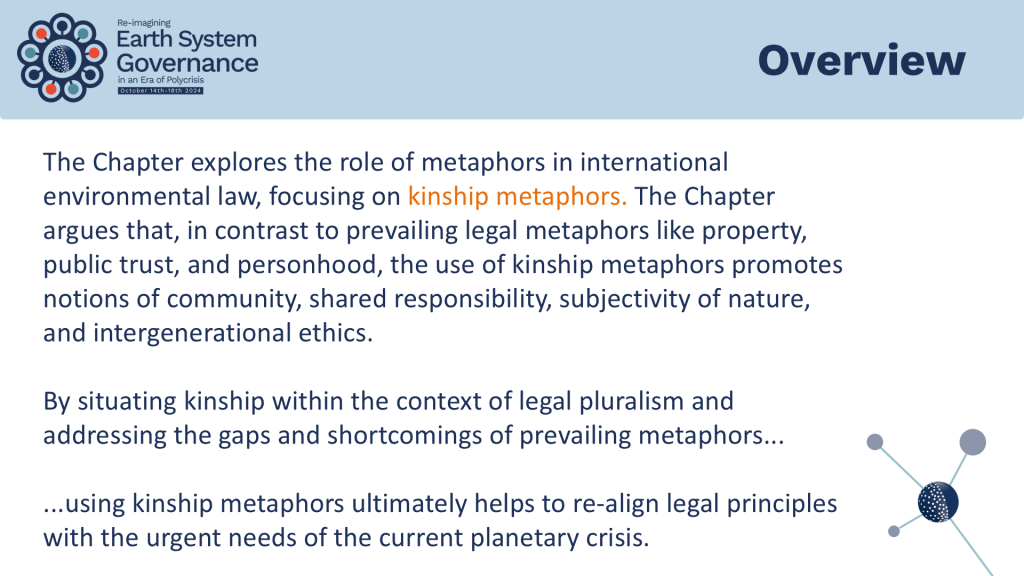
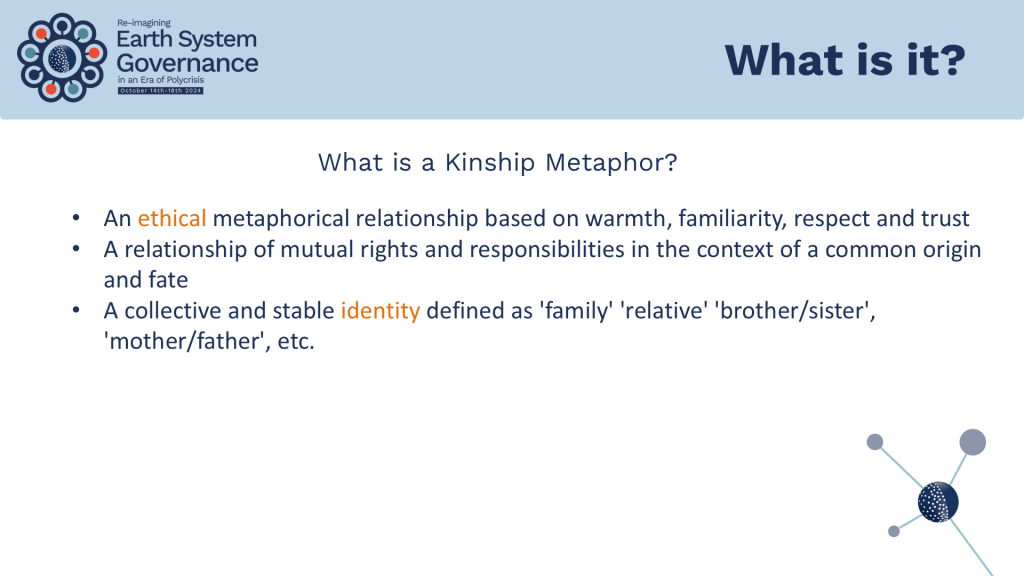
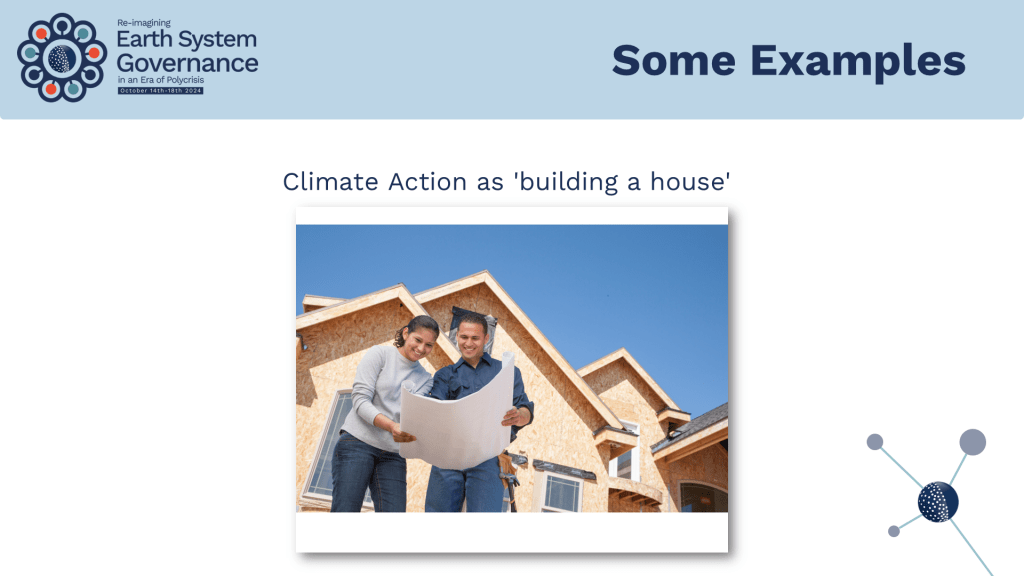
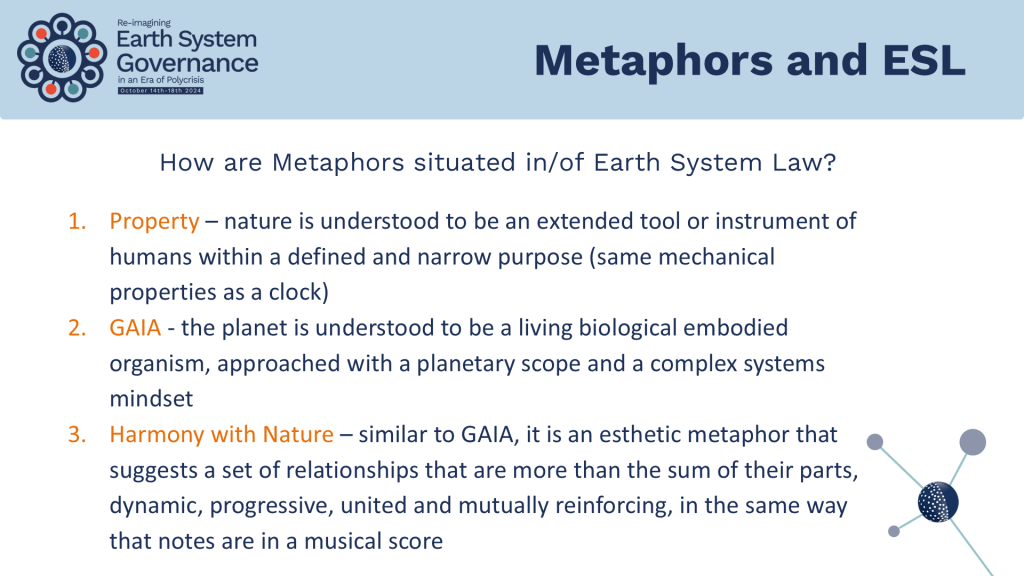
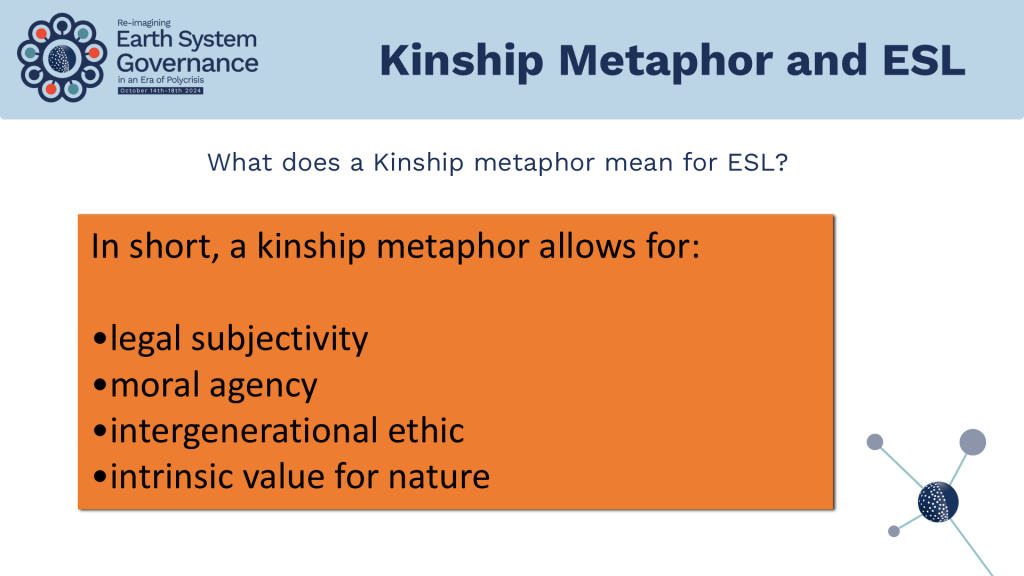
The presentation explores the role of metaphors in international environmental law, focusing on kinship metaphors. The work argues that, in contrast to prevailing legal metaphors like property, public trust, and personhood, the use of kinship metaphors promotes notions of community, shared responsibility, subjectivity of nature, and intergenerational ethics.
By situating kinship within the context of legal pluralism and addressing the gaps and shortcomings of prevailing metaphors…
…using kinship metaphors ultimately helps to re-align legal principles with the urgent needs of the current planetary crisis.
Southern Resident Orcas are critically endangered despite legal protection
on KSQD 90.7 FM, KSQT 89.7 FM, K207FE(FX) 89.5 FM and KSQD.org
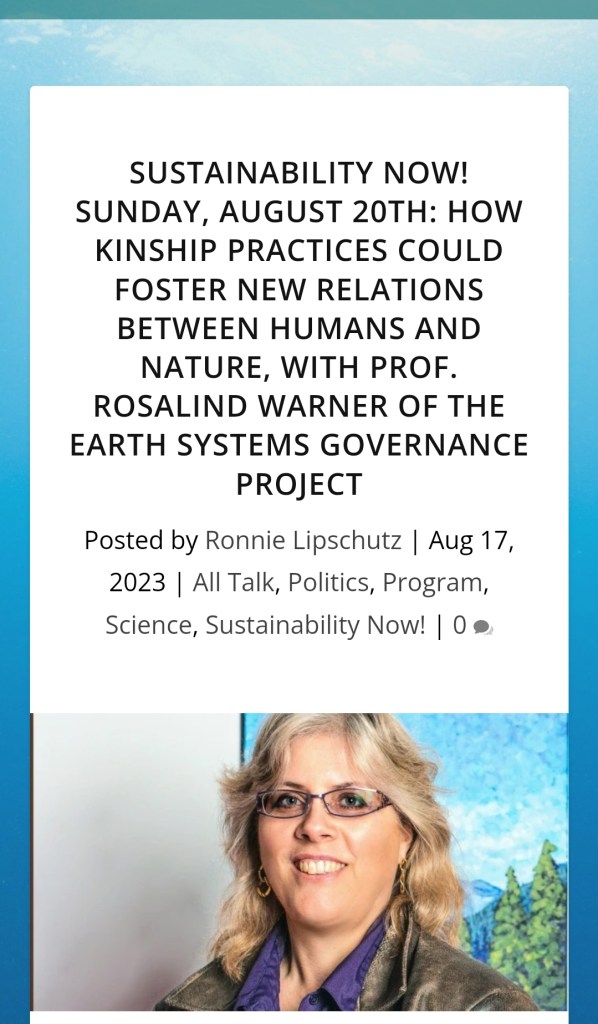
The Rights of Nature is one way to rethink the relationships between humans and Nature, but are there other ways to think about those connections? Join host Ronnie Lipschutz for a conversation with Dr. Rosalind Warner, professor of political science at Okanagan College in British Columbia and Research Fellow with the Earth System Governance Project. Warner is studying the role of kinship metaphors in Earth System Law, with kinship connoting more ethical relationships among humans, Nature and earth’s non-human inhabitants. Earth System Law is an emerging body of legal precepts, principles and practices that bring together ethics and law with the planet’s dynamic physical and biological cycles. Tune in to hear a new take on human-nature relations.
View video on CACOR‘s (Canadian Association for theClub of Rome) Youtube Channel.
Covid-19 disrupted the world in unimaginable ways. Future disasters may be even worse. Some argue human societies have left the Holocene Epoch and entered the Anthropocene. How might our perceptions of the human-nature relationship now change, and how might we improve policy, governance, and planning? [Note: one correction has been made to the slide set available on the CACOR website–there were 5 mass extinctions in the last 5oo million years. Ed.]
The foundational idea that women’s rights are integral to the politics of liberation, solidarity and justice has been mainstreamed in many international agreements and organizations.
The momentum on women’s rights should now be strongly carried forward to inform the politics of climate and security.
Moving forward, the need to mitigate and adapt to climate change means the world will be pushed to recognize and institutionalize the principle that women’s security is human security.
The challenge is urgent, the climate will not negotiate. Any efforts to address climate change will be that much poorer for the absence of women’s voices and experiences. Any efforts to address climate change will be that much richer with the power, strength and leadership that women bring as agents of change. The need for human security gives even more reason to ensure that women are not left behind.
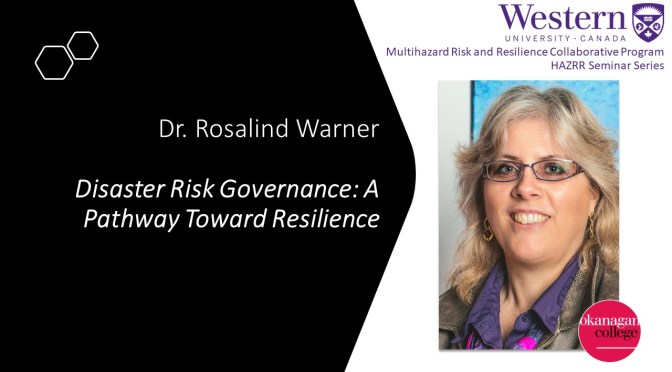
COVID-19 disrupted the world and peoples’ lives in unimaginable ways. It seems likely that future disasters, whether natural or human-made, will be no less disruptive and challenging. This talk will explore how disaster risk shapes our policy, governance, and planning. Using examples, we will look at how risk is unevenly distributed, and how (and whether) we have learned to better prepare and reduce loss and damage from future disasters.
A talk for the Multihazard Risk and Resilience Group Seminar at the Western University. MARCH 25, 2021
Canada’s response to global disasters has been characterized by a certain degree of push and pull between the domestic and the international levels, and between the provision of immediate relief and the support of long-term resilience and risk reduction. In the area of disaster risk reduction, progress at the international level since 2011 has been marked by a sustained movement away from reactive and relief-based approaches toward “disaster risk governance”. As a signatory to the Sendai Framework on Disaster Risk Reduction, Canada has been a supporter of this move as well as the move to integrate disaster responses with the Sustainable Development Goals (SDGs), blurring the boundary between “relief” and “development” activities and policies. In this talk, I will explore the meaning of ‘disaster risk governance’ as it is addressed in the Sendai and Hyogo Frameworks, and consider practical examples of how a shift toward governance might improve disaster responses by the Canadian government, and in turn, reduce loss and damage from disasters.
Talk scheduled for October 18th. Oil is essential to industrial society as we know it. The history of the industrialized world has been shaped by changes in the environmental, economic, social, and political dimensions of oil. In this session, we will learn about the history, the present challenges, and the future of oil in an environmentally-stressed planet. Participants will emerge with a deeper appreciation for the complexities of oil politics.
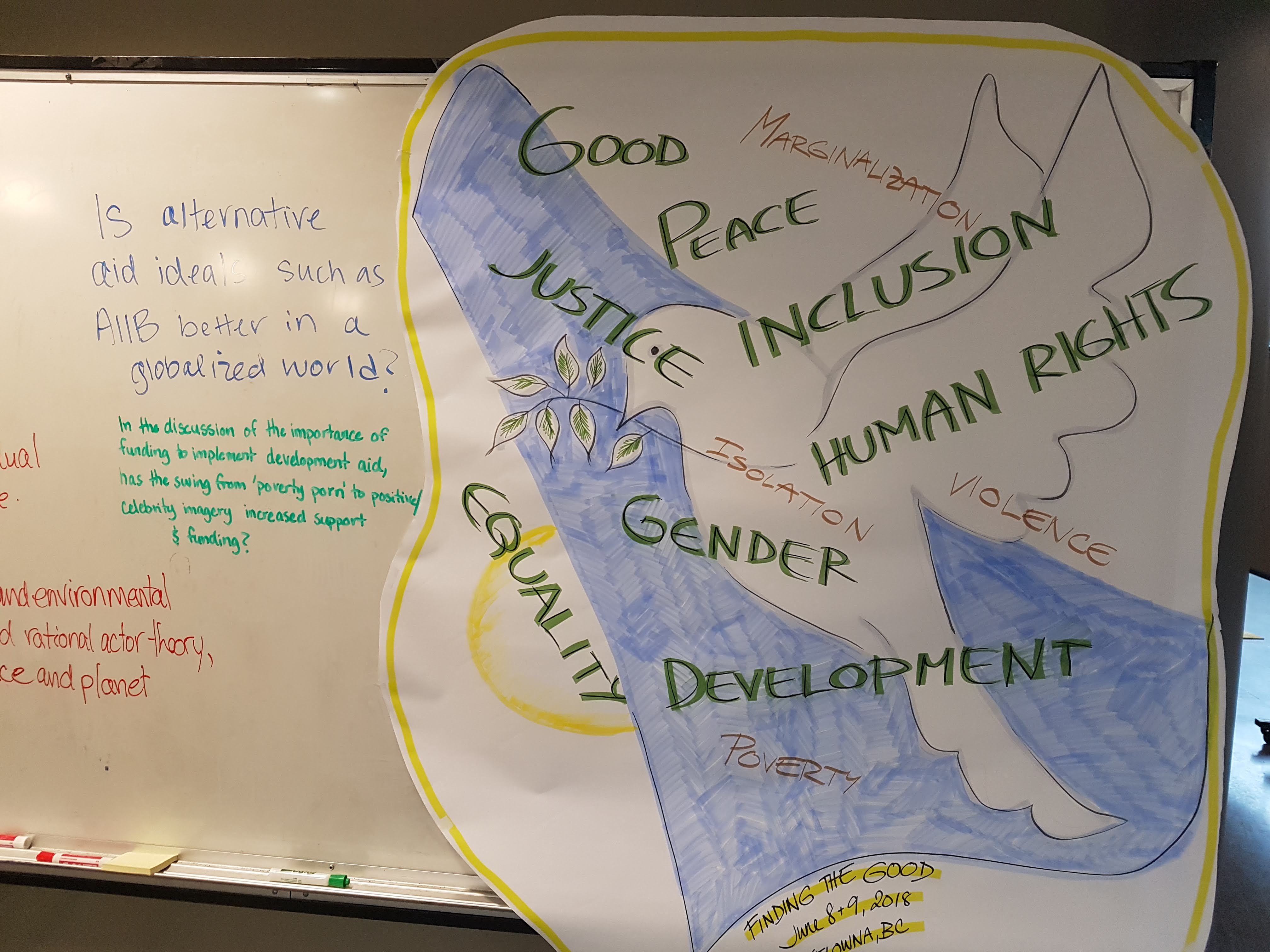
On June 8th and 9th 2018, researchers, students, community members and practitioners gathered at Okanagan College to explore ways of articulating and sharing ethical international development ideas and practices. 50 attendees from across North America joined with leaders locally at Okanagan College’s Kelowna campus for an intensive 2-day conference and dialogue on equality, inclusion, and human dignity. Scholars and practitioners interacted in engaging sessions on gender, local governance, corporate social responsibility (CSR) and the United Nations Sustainable Development Goals (SDGs).
Keynote speaker Chloe Schwenke, former Director of the Global Program on Violence, Rights, and Inclusion at the International Center for Research on Women (ICRW), shared her experiences advocating for a human rights framework for development in the Obama Administration. A second Keynote with Michael Simpson, Executive Director of the BC Council for International Cooperation, built on the themes of leadership and change in a ‘Talkshow’ style interview that engaged the audience in generating new avenues of inquiry.
In addition to providing a summary resource to share the highlights from the two day Conference, the purpose of these Proceedings is to contribute toward a network in which dialogue between scholarly insights and practical development work can improve the participation of people experiencing poverty, social marginalization, discrimination, and oppression both at home and abroad.
For more information and to view the Proceedings, visit the Conference webpage.












 Dr. Rosalind Warner
You must be logged in to post a comment.