All posts by Dr. Rosalind Warner

My background includes graduate work in Political Science at York University's Centre for International and Security Studies, a one-year travel-study tour around the world focused on issues of peace and conflict resolution, and almost 30 years of teaching subjects from International Development to Canadian government. Recent publication includes Canadian Ecopolitics (2025 University of Toronto Press). I have researched and published on topics like ecological modernization, global environmental governance issues, protected areas governance in North America, environmental discourses, disaster risk reduction, global health, and environment and trade in Canadian foreign policy.  I am Associate Editor of the Canadian Journal of Development Studies, past editor of Unsettled Balance: Ethics, Security and Canada’s International Relations, and Ethics and Security in Canadian Foreign Policy, both with UBC Press. Recent article:  Governance for resilience: Canada and global disaster risk reduction, Canadian Foreign Policy Journal, 26:3, 330-344, DOI: 10.1080/11926422.2019.1699129.  I am Co-Director, along with Andy Knight, of the Canadian Defence and Security network’s Global Health Security Theme. I am a Research Fellow with the Earth System Governance Project, and Board Member of the Canadian Environmental Network. I speak and write publicly often on political issues of the day. All views my own.

What Kind of (In)Equality Do We Want?

Photo Credit: Jessica Tam Flickr

When analyzing any phenomena, it helps to have a good idea what we want to achieve. In political science as in life, equality has great significance. Analysts tend to think quite differently from the general public, however, about what constitutes equality and how we should use the term. Let’s consider a thought experiment to sort out the difference between ‘equality of opportunity’ and ‘equality of condition’.

If we imagine that equality of opportunity and equality of condition are kinds of ideal types at opposite poles, with a spectrum of variations in between, then the picture might look something like this: under ‘equality of condition’ everyone would experience the same life outcomes: equal incomes, equal standards of living, and equal levels of education, health care, and work. How would things differ? Likely inequality would creep in through limited means: for example, some may work longer hours, have more or less education, spend more or less time skiing, etc.

What is wrong with this picture? The most common criticisms of this ‘absolute equality’ are:

It reduces the incentive to succeed, and 2. It distorts the value of things, leading to scarcities and gluts in supply.

Society involves differential treatment.

But these are practical criticisms, not questions of justice.   Would absolute equality actually be ‘just’?  Assuming for the moment that such a system could be workable (and I’m not saying it is) then an argument could be made that it actually creates injustice by failing to differentiate among people with ascribed or inherent differences who deserve differential outcomes.  Those who work harder or are more creative or who are disabled or ill should be treated differently.  Some may deserve preferential access to resources either as a result of their extra effort, their accomplishment or contributions, or by virtue of need.  Tellingly, the right more often argues for differential outcomes based on effort and accomplishment, while ‘need’ tends to take second place. It is sometimes said that such a system would be communistic.  However, under Marx’s vision of communism, the ideal form of equality actually allowed for differential rewards focusing on need rather than accomplishment or contribution. Contrary to popular belief, Marx did not advocate absolute equality of condition. Indeed, nobody has, in all seriousness, ever really proposed that large-scale industrial societies impose absolute equality of condition.  This is because serious thinkers would quickly realize that equality of condition, even in its ideal form, would inevitably raise both practical and fairness questions since there would still need to be some argument for different treatment of some people.  Nobody is average.

Now, what about equality of opportunity? That sounds like something we can all get behind: everybody can try or fail equally well, and those with the greatest accomplishments and talents will rise to the top. This is kind of what Paul Summerville argues when he says:

Equality of opportunity is a virtue when it is twinned with unequal outcomes. It is meaningless without it. What is the point of equality opportunity if success is discouraged by custom, law, or taxation?

But, to respond to this, how can we be sure that everyone actually has an equal opportunity to try, and to win? Inequality all by itself is not evidence of equality of opportunity. What if the winners try to ‘kick the ladder out’ from behind them, blocking the upward advance of others? What if they use their newfound positions to favour their heirs and families and friends rather than allow their loved ones to fail? Perhaps when we see that some are able to climb up to the top from the very bottom of the social ladder without artificial assistance from the state, then we can say that equality of opportunity exists. But how many of these examples are sufficient to prove it? One? One in ten? One in a thousand? The fact is there is no natural or inevitable level of inequality that can tell us when everyone truly has an equal chance. We can point to clues: perhaps when the top 1% is as diverse and representative of the entire society, or when every member of the top group can claim to have climbed out of the gutter, but that seems as unlikely as the ideally equal society discussed above. The question of fairness rises again: even in a society in which opportunities are purely equally distributed, there will be unfairness due to the same factors mentioned above: What about those disadvantaged by illness or age or poor upbringing? What about highly talented or accomplished individuals who don’t manage to make it through no fault of their own? why value some talents more than others?

Given differences, how can we be sure that equality of opportunity exists?

Again, the argument to treat some people differently in order for equality of opportunity to be realized is present. But, the same question arises: what should be the basis for differential treatment? Here, the differences between the two poles start to disappear: the essential argument is not about equality at all, but about the basis and rationale for differences. Both sides work toward an ideal world that is impractical and unfair, yet both sides argue for ‘differential’ treatment on the basis of different individual characteristics. The right argues that differential treatment should be based on talents or contributions, while the left focuses on compensating for special needs and other (class) disadvantages.

The world we actually live in is of course far more complicated. Equality before the law, which is the dominant discourse of equality in Canada and other Western liberal democracies, is actually a fall-back position avoiding both of the options described above. It doesn’t guarantee equality of opportunity and it doesn’t mitigate inequalities of condition. At most, it provides a measure of our progress toward some compromise on fairness and practicality. It’s not irrelevant, far from it! The legal guarantees of the Voting Rights Act or protections for gay marriage or for equality between religious beliefs do matter, but not for the reasons we think. They matter less because they create equal opportunities, and more because they clarify the legitimate grounds for treating people differently. The fact that people are all, in some way, treated differently by society still needs to be acknowledged by all participants in the equality debate.

The next two blog posts will address the sources of present-day inequality in globalization, and the basis for differential treatment and its centrality to equality.

Further Reading: Tax the Rich (More)!

For those attending the Munk Debate livestream on May 30th:

Munk Debates   The DebatesPaul Summerville, University of Victoria economist, recently wrote a series of blogs on the topic of equality and inequality.  You can find them here:

“Guest Post: A History of Equality” May 14th, 2013 The Inside Agenda Blog 

“Guest Post: The Difference Between Decreasing Inequality and Increasing Equality” May 22nd, 2013 The Inside Agenda Blog 

“Guest Post: Why We Need Winners and Losers” May 28th, 2013 The Inside Agenda Blog 

David Miller responded:

“Guest Post: The Economic and Democratic Harms of Income Inequality” May 29th, 2013 The Inside Agenda Blog 

The Globe and Mail also has run a series of blog articles by debaters, you can find them here: 

Can currency wars lead to real wars?

Are we in a potential inflationary moment?

Imagine the following:  China secretly buys up gold futures in the hopes of stockpiling a war fund to fight inflation caused by US ‘quantitative easing’.  If the US goes too far in trying to fund its stimulus by debasing the dollar, China triggers a crisis by buying up gold.  The ultimate statement of lack of confidence in the US dollar (which is the key currency for all international trade and capital reserves) leads to a catastrophic run on the dollar and a collapse of globalization as each country tries to ‘beggar’ its neighbour with cascading tit for tat devaluations.  In his book Currency Wars: The Making of the Next Global Crisis, Jim Rickards presents several scenarios by which the world could come to the brink of collapse as a result of governments’ efforts to manipulate their currencies, thereby stimulating their economies at the expense of their trading partners.  Indeed, it is not hard to imagine how the monetary underpinnings of globalization could easily come crashing down given the wobbliness of the top currency, the high level of US debt, and the lackluster response of the US consumer, traditionally the world’s growth engine, in recovering from the 2007 recession.  Indeed, one could argue that even a much less complicated scenario might lead to crisis:  what if China simply decided to use it’s so-called ‘nuclear option’ and stop buying US treasuries, triggering a cascading dive of confidence in the world’s reserve currency?  What if politics really did take over economics?

The alarmism over a coming hyperinflationary crisis appears to be growing, and it’s not without some foundation.  Fiscal stimulus appears to have met its match in the global system of monetary exchange, where politics and economics do not just interact, but essentially meld.  However, at least some of the alarmism should be taken with a grain of salt.  The calls for curbing the US fiscal deficit (quite apart from the debt) are at least in part motivated by an ideological discomfort with government’s influence on the market as well as a moral panic over Americans’ dependency and perceived complacency.  This view tends to see the world as a dangerous, zero-sum place where countries await any and every opportunity to force an advantage over their competitors.  However, economic competition is not exactly the same as political rivalry, and should not be equated.  While it is not impossible for countries to mutually try to obliterate each other (see the Great Depression) it is not likely given the availability of much more palatable options.

Economic and political 'wars' should not be equated
Economic and political ‘wars’ should not be equated

It is important to remember that unlike real wars, currency wars that result in hyperinflation are not really deliberate—they result from governments’ fumbling and lack of effort to cooperate or lead rather than from single-minded plans to dominate the world.   They are tragedies (or tragicomedies) rather than evils.  They are not so much caused by politics as by a lack of politics.  Because of the uncertain results of currency manipulation, it is a very blunt and unpredictable instrument of policy indeed.   As with nuclear deterrence, mutual deterrence is more likely than not to push countries to cooperate and to head off crises before they get out of hand.  Indeed, this is exactly what has been happening for the last (almost) 42 years.   The players may change, but the game will remain: keep the poker face on and ensure the world continues to have a world reserve currency with some usefulness to everybody.   The alternative is just too awful to contemplate.

Public Service: A Paradigm Shift in the Heart of Government

95556699

It is easy to complain about public employees: are they not a privileged, elite, sheltered group?  It seems that public employees and the cost of public payrolls are, yet again, in the sights of critics from the right.  In particular, attacking the ‘burden’ on taxpayers of ‘excessive’ pensions, benefits, and salaries is an easy and simple way to short-circuit a serious political discussion.  In Canada, such attacks do not tend to have the racist overtones they have in the US, where a growing segment of public employees come from black, Latino or other racial and ethnic minority groups.  Nevertheless, such attacks can be scathing. 

One thing about these criticisms is that they essentially miss the point.  The purpose of government is not the same as that of business, nor would taxpayers truly want their government to be run like a private for-profit enterprise.  Imagine peoples’ reaction if the prices of government services truly followed the laws of supply and demand: the price of healthcare, prescriptions, surgeries, education, road and infrastructure construction, and a whole host of other high-demand items and services would be so high that it would quickly render many private businesses uneconomic.  Imagine if every individual had to pay directly for their own education, health care, road use, sewers, personal protection, water, etc.? 

IfQYvThe whole idea of having government deliver these services is the general recognition that these common goods are most efficiently (and cheaply!) delivered at collective cost, and by extension, that their operation and administration should be overseen by publicly-appointed administrators who are accountable for the expenses that are taxpayer-funded.  You only need to spend a short amount of time in a country with a broken or absent public service to realize the importance of it. 

While there is room for debating the extent and scope of public administration, there should also be acknowledgement within the debate that public service is not only legitimate and necessary, but beneficial.  In the interests of shifting the discussion and possibly even changing the paradigm for public service, here are some ideas for thinking differently about public service:

Outcomes matter more than efficiency

When patients get better, when special needs adults are able to live independently, and when kids master a new skill, real social goods have been accomplished that save taxpayers money in the long run.  Such a calculation simply cannot be reduced to a yardstick that trades off today’s revenues and expenditures.  When these outcomes are compromised by budget cuts, not only do individuals pay a price, but the social costs are borne by everyone in society.

Incentives erode the soul of motivation

Talk of ‘rewarding excellence’ and ‘reducing the redundant’ does NOT improve performance.  Competition is not the point of public service.  Trying to incentivize outcomes increases stress and makes people resistant to change.  Companies are discovering this on their own in recent years, but they are also discovering that a decent level of compensation is a prerequisite to a motivated, creative, and productive employee in any enterprise.

Bureaucracy means fairness

This may be a hard sell, but next time you’re waiting in line for a drivers’ license or filling out a passport application, consider the effort and expense required to ensure that all of those who use public services are treated consistently and fairly.   Then consider what happens when those services are cut or reduced.    How much is fairness worth to you?

Cutting services is self-defeating

In the open market, fraud and deceit flourish because businesses lack the ability to police themselves and are highly motivated to abuse their power and superior knowledge. The cost to legitimate businesses in restoring confidence when violations occur is significant. A large part of what government provides is trust and confidence when the market fails, which allows businesses to be profitable.  If business is less profitable, economic activity slows and tax revenue falls.  Beyond the purely instrumental argument that austerity directly reduces economic growth, austerity is self-defeating because it increases the hidden costs of doing business in hard times. 93442034

Public servants create wealth, and create the conditions that enable private businesses to create wealth.  Of course governments should be accountable for costs, especially since the disciplining competition of the market is less sharp and the high demand for public goods and services can tend to push prices up.  However, the solution is not to heighten competition but to recognize and account for the benefits that public service provides, and not just to focus on its costs.  A truly balanced account would show that taxpayers are investing their resources very efficiently indeed.

The End of Impunity: Two Pathways to Justice

No Mubarak Egypt Uprising Photo Feb 2011 by Takver (Flikr)In Egypt this past summer, former president Hosni Mubarak and former interior minister Habib El-Adly were sentenced to life in prison for complicity in the murder and attempted murder of protesters in the 2011 uprising that removed Mubarak from power. In Liberia, Charles Taylor was convicted of war crimes and sentenced to 50 years for aiding Sierra Leonean rebels who raped, maimed, and murdered tens of thousands of civilians (Harper’s Weekly Review June 4th, 2012). In March 2012, the International Criminal Court delivered a guilty verdict against Thomas Lubanga Dyilo, who was found guilty of the war crimes of enlisting and conscripting children under the age of 15 years and using them to participate actively in hostilities in the Democratic Republic of the Congo between September 2002 and August 2003. At present, the ICC has publicly indicted 30 people, and has proceedings ongoing against 24, including against the top five members of the Lord’s Resistance Army in Uganda, including Joseph Kony, for similar crimes.World1

With human rights increasingly in the news, and the activities of multilateral agencies like the ICC at the forefront, it seems that two distinct pathways to criminal justice for egregious violators of human rights are now becoming evident. In the first pathway, former heads of state are held to account using the bodies of law of the country they once led. Under this pathway, the process can yield successes (as in the case of Mubarak) but it also has flaws. Judges appointed by the former leader may be reluctant to apply the rule of law, or, alternatively, too severe outcomes can actually undermine the rule of law by placing the whole process under suspicion. This is especially true if the society has a history of sectarian violence. In the latter case, for example, I’m thinking of the sham trial of Saddam Hussein following the US invasion of Iraq, which probably set back the rule of law in that country by decades and opened the door to a vicious sectarian war. It should be noted that until recently, with the establishment of the ICC as a legal body, national prosecution of such cases was, essentially, the only available route to justice.

The ICC was established to fill a gap in international human rights law that addressed some of these flaws. The gap lay between the politics of sovereignty and the universal laws of human rights. But the ICC was to be derivative of sovereign law, a supplement, and decidedly not a force for subversion or displacement of national bodies of law. Far from it. International law steps in where national law and politics fail, but fail first they must. It is through this pattern of repeated failure that the full justification and realization of the importance of the ICC to the system of sovereign law will emerge. For this reason, it is entirely wrong to criticize the ICC as toothless or helpless in the face of national power. It also entirely wrong to criticize the ICC for overstepping sovereignty The body of law upon which the ICC draws is the logical and reasonable outgrowth of sovereign law itself. For this reason, every case brought to justice by the ICC strengthens, not weakens, the force of sovereign law to protect human rights and bring violators to justice. Even though there are two pathways to justice, they are heading in the same direction, towards a world where violators will have nowhere to hide with impunity.

Student Showcase 2013

Political Science students at Okanagan College this past Fall term have worked very hard to prepare work on cutting-edge political topics and issues.  Students were challenged to analyze a political problem, consider various policy options, and come up with creative solutions.  Students prepared  blogs, analyzed images, presented their work in class, analyzed key actors, reviewed films, and prepared timelines, among many other things.  This showcase is a sampling of some of the best work done this term.  My thanks to all of my hard-working students.  I am blown away with the outstanding work that you do!

Aska Nakamura has put together a timeline of the Senkaku/Diaoyu Island Dispute as part of her work in the class Global Politics here at Okanagan College in the Fall 2012 term.  Her timeline is detailed and she relates the dispute to some of the themes of the course, particularly the importance of national interest in creating the conditions for conflict.  For anyone looking for a comprehensive yet detailed history of the dispute, this timeline is a great resource.

Senkaku


Chris Munger prepared an image analysis of a pivotal event in the history of world politics: Soviet leader Nikita Kruschev’s famous ‘shoe banging’ incident.  What is interesting about Chris’s description is the way he relates this picture to the larger context of world politics as fundamentally conflictual and anarchical.  Chris has taken a well-known incident and used it to make a valuable point about world politics.

clip_image002

This image, taken in 1960 of Union of Soviet Socialist Republics Premier Nikita Khrushchev while at the United Nations General Assembly, was a short time before the alleged (and infamous) shoe-banging incident. Khrushchev supposedly waved around or banged his own shoe on the desk during the assembly itself. Details of the event are debated (as evident by the wealth of conflicting versions circulating on the internet), but the incident and this photograph of an obviously unreceptive statesman illustrate a key issue in global politics. This issue is the adversarial attitude of global politics. The effectiveness of this international institution will not be argued here, but it is true that the United Nations is the most inclusive international political institution in the world and among the most extensive. Any incident involving shoe-banging (or any version thereof) would hardly be respectful of the institution’s goal of respectful debate, and continued vetoes by permanent security council members stymie the efforts at cooperation that the UN should facilitate. The USSR is an historic example of this.

So what is the greater connection to global politics as a subject? Adversarial attitudes within the UN are easily explained by realist theory to be a natural result of power struggles between sovereign states. However, it could also be a symptom of the realist approach itself. The United Nations, as an idea, is far closer to constructivist thought, as it depends upon norms and histories of cooperation between states to function. When a realist mode of thought is applied, the system breaks down and means such as veto power are employed to prevent cooperation. Realpolitik is incompatible with cooperation toward universal gains, and this is seen again and again as states see issues as divisive or as diplomatic wars to be won. Despite the prevailing paradigm of a state regarding political theory, attitudes should be in line with the agreed to means to achieve goals. One can little doubt the United Nations would be far more effective if members subscribe to a political theory that supports its intent, and constructivism should be more widely acknowledged to achieve this, if nothing else.

Works Cited

Leffler, Warren K. Nikita Khrushchev 1960. 22 September 1960. Photograph. Wikimedia Commons, 2006. Web. 28 September 2012.

URLlink to source:

http://commons.wikimedia.org/wiki/File:Nikita_Khrushchev_1960.jpg


Kassidy Hoffman’s map of Canada’s forest cover uses information from the World Resources Institute’s website to visualize the progressive loss of forest cover in Canada.  She prepared this work for the course Canadian Environmental Policy. In her description, she emphasizes how Canada must balance the use of forests with forest protection, a difficult call when economic activity demands the use of natural resources to boost GDP.

clip_image002[4]

Source Link:http://www.wri.org/publication/pilot-analysis-global-ecosystems-forest-ecosystems#data

A Map of Forest Cover in Canada

This map shows the distribution of forests within Canada. The green colour scheme indicates whether the forest is dense or sparse. The areas that are less dense in Canada are mostly alpine areas. I chose to produce a map of forests in Canada in order to demonstrate the importance of preserving Canada’s forests. British Columbia and New Brunswick tend to be the most logged provinces in Canada. Forestry is a very important industry for Canada because it helps the Canadian economy. This coincides with the Staples Theory because lumber is a raw material that Canada highly depends on for economic wealth. This map shows all forested areas; this includes natural forests and replanted forests after logging and/or a natural disaster, such as fires has occurred. Canada’s forests are slowly depleting and eventually the forests in Canada will be nonexistent.

I made this map by using data sources off of the World Resources Institute website and converted it into ArcGIS and converted it into a map. I then manipulated the colour scheme and created a proper legend; I added all of the necessary map elements.

The production of this map is relevant to the course because the map helps to visualize the forestry issues in Canada. The map shows how only parts of Canada are forested; there are no forests in the prairies and in the north where there is too much snow and ice. Sustainable Forest Management is a way Canada looked at sustaining and developing forests in Canada. There have been a lot of conflicts with forestry policies and this map proves forests are essential to Canada and that they need to be protected. Forestry is a big part of environmental politics because Canada needs the lumber; however, it’s a question of how far is Canada going to go when it comes to destroying the forests and realizing it is too late to protect Canadian forests.

The Place of Intrinsic Value in Environmental Politics

The news this year on the climate front continued to be alarming, especially the record low extent of summer sea ice in the Arctic.  The anthropocentric case for doing more to combat climate change seems self-evident.  A changing climate is very likely to be less hospitable to human needs than a stable one.  Arguments solely from self-interest therefore appear fairly quickly in the discussion of what to do.

But what of arguments not based on self-interest?  What place is there in the environmental discussion for a non-self-serving ethic, based on the idea that the natural world has intrinsic value, independent of human needs or human culture?  In fact, these ideas have been elaborated since the early days of the Does nature have its own intrinsic value?movement by Arne Naess and many others.  The notion of intrinsic value has seen its most prominent political expression in the discourses around parks and protected areas.  Groups like the Canadian Parks and Wilderness Society continue to be  influential in establishing that ecological integrity should be a guiding principle of parks governance.  Protected areas symbolize many things, but one of the impetuses for protection is the awareness and recognition of a natural world with its own logic, its own measures, and its own ethical integrity, independent of the human.

Arguments that go beyond human self-interest, however, have not made a huge impact in the climate debate.  One problem is that an ecocentric ethic has been too closely associated with wilderness preservation.  Wilderness preservation is a legitimate basis for political action, however, wildernesses today are too physically remote, too closely managed, and too narrowly defined to be a solid basis for elaborating a larger argument about intrinsic value.  Biodiversity holds more promise, since natural biodiversity can be understood to operate from non-human principles.

Searching for intrinsic value.But what if the biosphere changes radically in response to climate change, what then becomes of an ethic of static preservation and intrinsic value?


In fact, I would argue that the best way and most effective way to integrate an ethic of intrinsic value in political decision making is to use an expansive and embedded approach. Such an approach would first of all recognize that intrinsic value and use value are not mutually exclusive ideas, and that something can be valued both for its usefulness to humans, and for itself.  Aristotle used the example of eyesight.  We value our eyesight both for its usefulness (we can see things and interact with the world more effectively with sight) and for its intrinsic value (we can appreciate sunsets and see the faces of loved ones).   The key test is not whether it would benefit humans to protect it, but would we miss it if it were suddenly taken away?  We can all imagine the sense of loss we would feel if our eyesight were suddenly removed, and we can all imagine the sense of loss as species disappear from the tree of life and the biosphere becomes irrevocably changed and even degraded.

This is a basis for building political action because of its universality.   Cultures may not agree on the value of any individual species but they can agree on the big picture of loss.  Practically speaking, the notion of intrinsic value for Canadians can be easily compared to the language of the Charter of Rights and Freedoms. Just as rights require entrenchment and defence by government and ordinary citizens, so, too, does nature.

Let’s not be afraid of the language of intrinsic value.  It is already all around us in political discourse.  Arguing that nature should be protected for its own sake makes a more robust position in favour of protection possible.  For example, it puts the onus on oil pipeline companies and developers to prove the worth of their activities, rather than on nature to prove its worth in human terms.

Entanglement: The Enmeshment of the Economy and the Government

In quantum physics, there is the idea that a single particle can have an effect on a different particle many light years away.  Einstein called this ‘spooky action at a distance’.  In today’chicken_or_egg_400_clr_10064s globalized world, economic activity shows similar ‘spooky’ characteristics, indeed, it is virtually a truism to say that what happens in one industry or segment of an economy will inevitably affect others at great distances.   What is often overlooked in ideological debates between the right and the left, however, is the entanglement of the free market economy with the activities of government.  They are separate, just like particles separated by great distances, but they are so closely entangled. Action in one sphere will unavoidably affect the other. arrow_halves_join_400_clr_9621

Take, for example, the encroaching effects of the ‘fiscal cliff’.  An increase in taxes coupled with spending cuts, could potentially cause a drop of as much as 1% of GDP growth in the US.  The resulting reduction in economic activity would then impact government revenues, cutting into revenues just as measures to reduce the deficit kick in.  This makes these measures, therefore, essentially self-defeating.  Even a more measured response to deficit reduction that allows for some spending increase could potentially trigger inflation, since it will unavoidably give the impression that the government will just keep printing money to pay its debt. Inflation could also reduce economic activity and jeopardize growth, although it seems unlikely in the short term, by undermining investor confidence and leading to capital flight.  The result, as with the fiscal cliff, is the same: a hit to government revenues and a self-defeating policy.

The first step to breaking the cycle is to recognize that the favoured solutions of both the right and the left are both inappropriate in the present context.  Reducing taxes to stimulate the economy without accompanying measures to induce spending and investment just doesn’t work, there is no evidence of it ever having worked, and it does severe damage to the government’s ability to raise revenue.  At the same time, government spending does not have the growth-inducing impact as in the past because thuncle_sam_holding_money_pc_400_clr_1727e implied willingness to spend and borrow undermines investor confidence.

The solution lies in the awareness that government is both an economic actor and an economic hedge.  Contrary to the arguments on the right, government cannot just ‘get out of the way’ and let the market grow.  For one thing, it might grow somewhere else.  For another thing, markets need government to backstop their activities and stop them from imploding on themselves.  The sooner that people stop thinking of governments as part of the problem, and realize that free markets require governments to make decisions for the common good, the better off both the economy and the government will be.  Governments and markets are not the same thing, their purposes are different and their instruments are different, but they are irrevocably enmeshed together. 

A Leaner, Meaner Politics in the US: What About Canada?

In his book The Age of Austerity: How Scarcity will Remake American Politics Thomas Byrne Edsall argues that shrinking public and private resources will make politics leaner, meaner and less civil.  It’s not just that right and left disagree on how to distribute resources, it is a fundamental rift in the understanding of the purpose of the state itself.   It’s also not just a fight over ideas:  it is a battle for survival.  The supporters of the right, to pearth_tighten_belt_800_clr_7668araphrase Edsall, are ageing, embattled, middle to upper class whites living in decimated and depopulated suburbs who are increasingly bitter about the direction of the redistributive state.  In the past, the right’s call to arms was a kind of negative freedom (‘Don’t Tread on Me’) which fought to preserve the individual’s ability to choose their own forms of happiness unimpeded by state regulations.  The premise of this, we know now, was the expectation that everyone could gain from a growing pie.  No more.  Programs for which supporters of the right are the primary recipients (including Medicare and social security) are considered sacrosanct.  Programs from which others benefit (read black, immigrants, poor or public sector workers) like Medicaid, the Patient Protection and Affordable Care Act, or income supports, are untenable ‘entitlements’.  On the left, there is a counter-move to protect the public sphere from erosion while simultaneously trying to remain coherent in the face of a fiscal crisis and an unrelenting personal attack on Obama during an election year.  The left is increasingly turning to middle class minorities, immigrant and young voters who are far less steady in their support and are on the whole less well-established and more vulnerable both economically and politically.

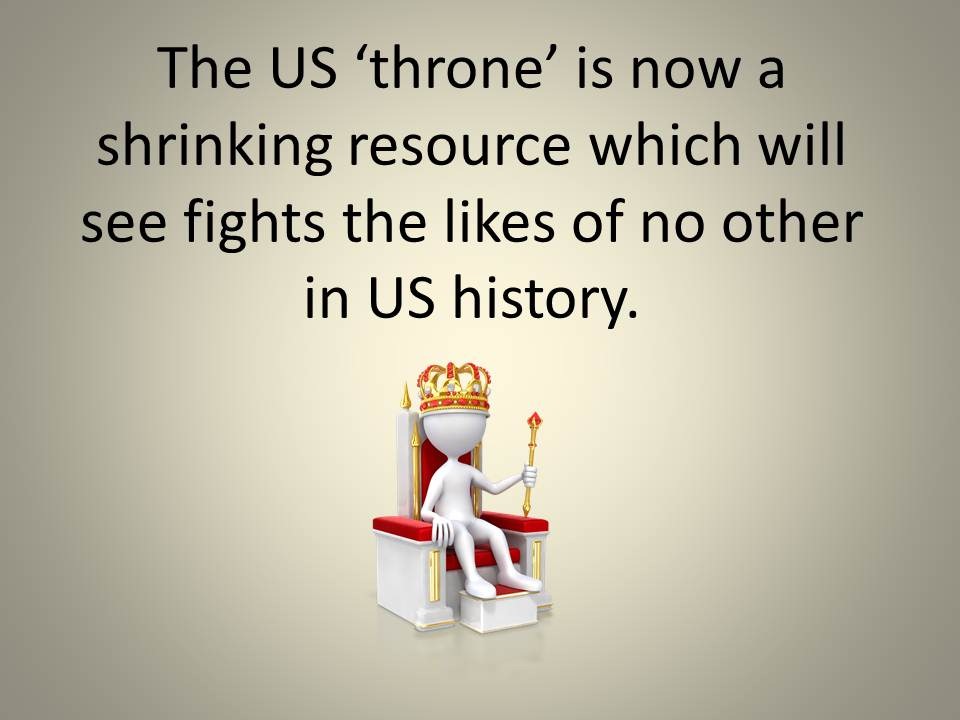
These kinds of politics reveal rifts that have historically deep-soil_money_canada_pc_800_clr_2385eated roots but which linger below the surface until austerity and crisis reveal them.  What rifts lie below the surface of Canadian society that have been eroding the social consensus gradually and unrelentingly?  Could Canada go down a similar route?  Recent battles paint a picture of the possibilities.  With vitriolic flourishes the Harper government and environmentalists are fighting an increasingly pitched battle over oil resources.   The push for a pipeline to expand foreign markets for oil, whether through a Northern route or Keystone, has as its root a long-standing fear that overproduction of oil will drive the price down and shrink profits.  This is a real fear, since the flattening of oil prices will make the billions of dollars already invested uneconomic, and capital will flee.  On the one hand, it seems more like an embarrassment of riches than a problem of austerity: oil consumption is maintaining a steady stiff pace overseas and is set to grow, along with its negative climate impacts.  On the other hand, it has all of the set piece features of a zero-sum fight over a shrinking resource.  As anti-fossil fuel efforts grow, and as more bitumen-type oil production facilities are being developed in Latin America and more unconventional oil is prospected in the Arctic and other areas, the chances of oil revenues becoming restricted in the future is higher and higher.  If this happens, look for politics here to follow a similar path to those in the US, with the centre of the storm being the role of shattered_dollar_coin_800_clr_8730the state as a (re)distributor of resources.  With potentially shrinking state revenues due to tax reductions and few other signs of growth outside the resource sector, the temptation to retrench at the expense of the poor, immigrants, the disabled and other marginalized groups may well be irresistible.  On the other hand, another fight between regions in true Canadian fashion may be brewing.  I want to end on a positive note here.  Everything I’ve learned in teaching young people about politics in the last 15 years has taught me that if anything, youth are more accepting, welcoming, compromising and diverse than ever.  I can only hope that these qualities will enable the cultivation of a middle ground in the future in Canada that seems increasingly elusive in the divisive and paralyzing politics down south in the US.  If we are to believe Edsall, however, austerity could bring out the worst in all of us.

An American Game of Thrones

As a graduate student, my academic advisor once told me that despite its hype, the American Revolution did not so much create a new system of government as replace one king with another.  The President has king-like symbolic power over the nation’s direction.  For this reason, and because of the diminished stature of the US in the world context, the US ‘throne’ is now a shrinking resource which will see fights the likes of no other in US history.  The polar opposite visions of the country will shrink the middle ground and with it the scope for any real action to be taken.  As the real power to influence events wanes, the symbolic power of the Presidency takes on ever more vitality.  Just look at the way that the President is personally blamed or celebrated (depending on the jobs numbers) for economic turns of events over which they have virtually no control.  Electing a new ‘monarch’ has all of the trappings of a winner-take-all fight in which, to paraphrase Cersei Lannister of Game of Thrones fame, ‘you win or you die’.  In this battle, the rules of engagement are murky.   The US ‘throne’ is now a

Ultimately, the game of thrones, whether in American politics or in the popular HBO series to which I have become hopelessly addicted, is about leadership.   The abiding moral paradox is that to earn the throne one must be ruthlessly focused on its attainment, but to keep it requires wiser, more subtle finessing and the ability to keep that ruthlessness in check when necessary.  This is the central distinction that Machiavelli made 500 years ago, encapsulated in the term ‘prudence’.   Warriors like Robert Baratheon (or George W. Bush)  fail as leaders because they lack the necessary diplomatic skill to inspire and activate their symbolic power.   Masters of finesse like Barack Obama (read Ned Stark) must constantly balance their leadership with the necessary hard edge needed to deter challengers, both domestic and abroad.  Such leaders do not necessarily relish or celebrate the violence they must commit.  But, taking the moral high ground can be hazardous to their health.

And what of the Lannisters (er, Mitt Romneys) of the world?  Wealth doesn’t automatically bring wisdom or the prudence necessary to rule.  The wealthy often prefer to manipulate things from the background rather than step forward to and take the power commensurate with their wealth.  In fact, the corruption that wealth brings erodes the necessary respect for power that is a requirement of prudence (Joffrey the false heir apparent, is a clear result of this corruption).  Romney, like Tywin, must constantly keep the ‘lower’ urges of his ‘clan’ from damaging his image.    Ned Stark

In this new age of symbolic power, appearance matters far more than reality, because to focus otherwise risks revealing the appalling truth: the President has little actual power to affect the economy, world affairs, or domestic governance.   The real decisions made in boardrooms, central bank meetings, and war rooms will go ahead with little reference to political affairs.  Collaboration will occur increasingly in secret, while the public sphere will be characterized by unending conflict.  To twist an old adage, in order to get anything done, it must not be seen to be done.